
Midnight Mass in Spanish: Planning a Bilingual Christmas Eve
How a parish plans Midnight Mass in Spanish, or one Christmas Mass for Spanish- and English-speaking families: readings, music, homily, interpretation.
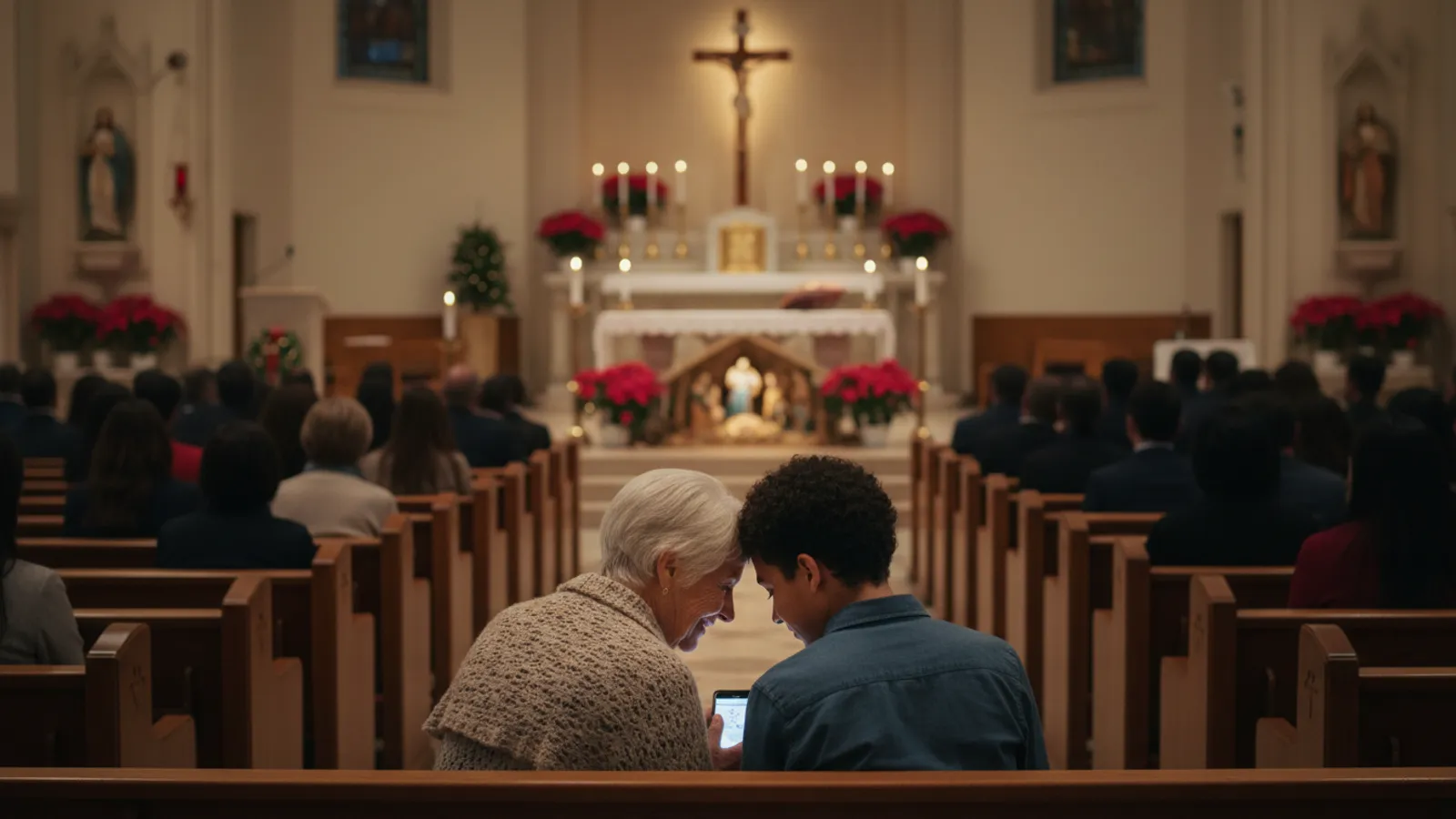
Midnight Mass is the Mass most families do not want to miss. Grandparents come who rarely come on Sundays, cousins fly in, and children stay up late for it. For a parish with a Spanish-speaking community, the question every year is the same: a Midnight Mass in Spanish, a Midnight Mass in English, or one Mass for everyone?
This guide is for the pastors, liturgy coordinators, music directors and parish office staff who answer that question in November, so that nobody is improvising on December 24.
What people mean by "Misa de Gallo"
In Spain and much of Latin America, the Mass of Christmas night is called the Misa de Gallo, the Mass of the rooster. Many Hispanic families will use that name when they ask the parish office what time it starts.
Two notes help avoid confusion:
- In the Philippines, Misa de Gallo usually means the nine dawn Masses before Christmas (Simbang Gabi), not the Mass of Christmas night. If your parish has Filipino families, say which one you mean in the bulletin.
- Many parishes no longer celebrate it at midnight. A "Midnight Mass" at 10 p.m. is common and kinder to the choir, the children and the ushers. Put the real time on every flyer, in both languages.
Three ways to schedule it
Two Midnight Masses. One in English, one in Spanish, often an hour or two apart. Each community gets a full Mass in its own language, but you need two choirs, two sets of ministers and a priest who can manage both.
One Spanish Midnight Mass, one English Mass earlier in the evening. This is the most common pattern. The English-speaking community takes the 4 p.m. or 6 p.m. Christmas Eve Mass, and the Spanish community keeps the late Mass. It works until mixed families come to the late Mass together.
One bilingual Midnight Mass. One celebration, two languages, the whole parish together on the night it most wants to be together. It takes more planning. The rest of this guide is about this option, though the homily advice also fits a Spanish Midnight Mass with English-speaking visitors.
Dividing the Mass between two languages
The Mass during the Night has its own readings: Isaiah 9 (the people who walked in darkness), Psalm 96, Titus 2, and the Gospel of the birth of Jesus from Luke 2. A simple pattern for a bilingual Midnight Mass:
- First reading in Spanish, second reading in English, with both texts printed in the worship aid
- Psalm with a bilingual refrain, verses alternating
- Gospel proclaimed in one language, then the other. Luke 2:1-14 is short enough to read twice, and on Christmas night nobody minds hearing it again
- Prayers of the faithful alternating, one intention per language, with a response everyone can say
- The Creed and the Our Father prayed by each person in their own language at the same time
Music does much of the work at Christmas. Noche de paz and Silent Night share one melody, so you can sing verses in each language. Adeste Fideles in Latin belongs to no one community. Ask the Spanish choir which villancicos their families expect.
The homily is the hard part
The readings are printed and the prayers are known by heart. The homily is neither. It is the one part of Midnight Mass where people most want to understand every word and where the worship aid cannot help them.
The usual choices are to preach twice (the Mass gets long, very late at night), to alternate paragraph by paragraph (only works with a homilist truly fluent in both languages), or to preach once and interpret.
Interpreting used to mean a bilingual parishioner interpreting at midnight instead of sitting with their own family, plus receivers and headsets. Live interpretation on people's phones is now another way.
Live interpretation on parishioners' phones
This is what Heartongue does. A laptop at the sound desk takes the audio from your mixer. People scan a QR code printed in the worship aid, choose their language, and follow the Mass on their own phone with captions and a natural AI voice, about two seconds after each sentence. Nothing to install, nothing to hand out at the door.
For Midnight Mass that means:
- The homily is given once. The priest preaches in Spanish and the English-speaking relatives follow on their phones, or the other way around.
- Language changes are followed. Heartongue detects the language of every sentence, so when the Gospel is proclaimed in Spanish and then in English, each listener keeps following in their own language.
- Visitors are not left out. The same broadcast serves several languages at once, from 49, so a visiting Portuguese- or Vietnamese-speaking family can follow too.
- The hall can follow as well. If the church overflows, as it often does on Christmas Eve, a presenter screen in the parish hall can show the captions next to the video.
It is machine interpretation and it is not perfect. A name can come out wrong, and a noisy room or a bad microphone makes everything harder. Test it before the night (more on that below).
Christmas words the way Catholics say them
A generic translation app pointed at the ambo translates word for word and invents its own Bible wording. On Christmas night, when everyone knows the story, that shows at once.
Heartongue translates the way your parish speaks. When the deacon proclaims the Gospel, each listener reads the verses from a Bible in their own language, marked 📖 with the reference. The angel's words to the shepherds, Luke 2:10-11:
English (World English Bible, Catholic edition): "Don't be afraid, for behold, I bring you good news of great joy which will be to all the people. For there is born to you today, in David's city, a Savior, who is Christ the Lord."
Spanish (Santa Biblia libre para el mundo): "No temáis, porque he aquí que os traigo una buena noticia de gran alegría que será para todo el pueblo. Porque os ha nacido hoy, en la ciudad de David, un Salvador, que es Cristo el Señor."
One honest limit: the readings at Mass come from the Lectionary, and its translations are licensed editions that Heartongue does not include. Quoted verses appear in the wording of one of 37 free, public-domain or openly licensed Bibles, which can differ slightly from what the lector reads.
Catholic listeners also get Catholic words: la Eucaristía, not la Santa Cena. When the congregation prays the Our Father or the Creed, each listener reads it as Catholics pray it in their own language. And when the pastor thanks the choir and reminds everyone about the Christmas Day Mass times, that stays plain speech, not Scripture.
Before Christmas, add your pastor's and deacon's names and your parish's patron to the glossary. Your team can also fix a term during Mass.
A checklist for December
- Decide the schedule by mid-November. One bilingual Mass or two, and at what real time. Put it in the bulletin in both languages.
- Agree on the pattern. Which reading in which language, how the Gospel and the homily will work. Share it with the priest, deacon, lectors and both choirs.
- Pick the music together. At least one carol both communities can sing in their own language at once.
- Build the worship aid. Readings in both languages, the responses side by side, the QR code for live interpretation on the first page.
- Test on an ordinary Sunday first. Run live interpretation at a regular Spanish Mass in early December. Check the sound, the Wi-Fi in the church and the glossary, and ask two or three parishioners to try it.
- Announce it once, simply. Before Mass: "If you would like to follow the homily in English, scan the code on the first page of your booklet." Then the same in Spanish.
- Ask afterwards. In January, ask a few families from each community what worked.
What it costs
Heartongue counts language-hours: one hour of broadcasting translated into one language that someone is actually listening to. A ninety-minute bilingual Midnight Mass followed in English and in Spanish uses three language-hours. Languages nobody listens to are not charged.
Every parish starts with 2 free language-hours, enough to test at a Sunday Mass in December. After that it is $4 per language-hour, or the Parish plan at $149 a month for every Mass in every language your parishioners need, without counting hours. The details are on the pricing page.
Plan it now, pray it together
The best bilingual Christmas Masses are planned before Advent. Choose the schedule, talk to both choirs, and test live interpretation at a Sunday Mass in early December, so that on Christmas Eve the whole parish hears the Gospel of the Nativity in its own language.
See how Heartongue handles Spanish translation for church, or read our guides to the bilingual Mass and the Catholic Mass in Spanish with English translation.
More from the blog
Funeral Mass in Spanish: Planning for a Bilingual Family
Heartongue8 min read
How a parish plans a funeral Mass in Spanish or for Spanish- and English-speaking relatives: readings, homily, words of remembrance, interpretation.
Church Translation App: How to Test One Before Sunday
Heartongue7 min read
A church translation app can sound fine in a demo and fail at Mass. Five tests for a weeknight: a Bible verse, a prayer, church words, an idiom, announcements.
Church Services in Portuguese: Live Translation Guide
Heartongue7 min read
How parishes and churches offer Mass or a Sunday service in Portuguese, live on phones, with Catholic and Protestant wording each listener knows.
Try it at your next service
2 language-hours free, no card needed. Set up a room in five minutes.
 Product Hunt
 Indie Hackers
 Fazier
 StartupBase