
Church Translation App: How to Test One Before Sunday
A church translation app can sound fine in a demo and fail at Mass. Five tests for a weeknight: a Bible verse, a prayer, church words, an idiom, announcements.
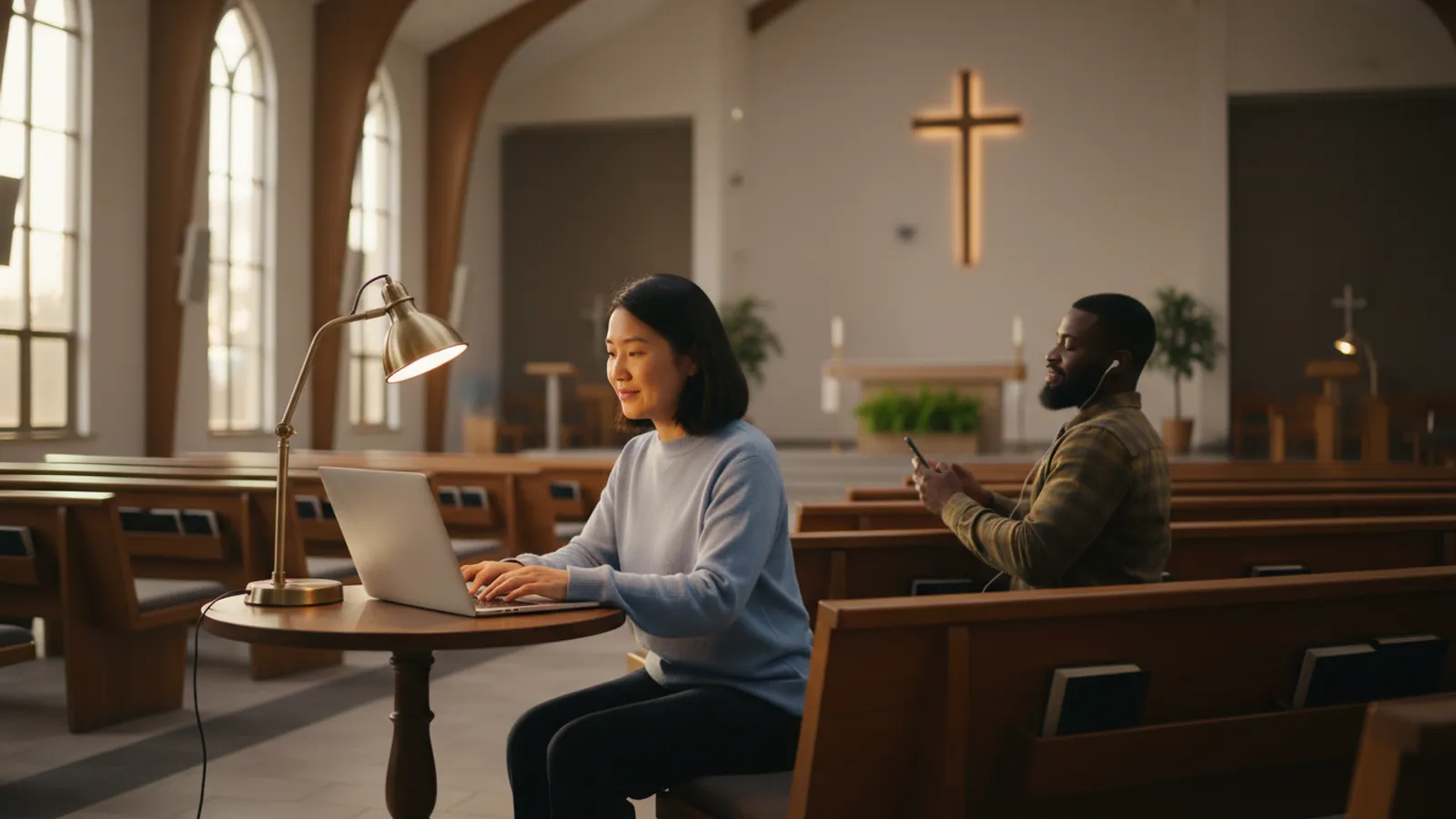
Most churches find a church translation app the same way: someone searches, watches a demo, and it sounds impressive. Then the first real Sunday arrives, the pastor reads from Matthew, the congregation prays the Our Father, and the people listening in Spanish or Vietnamese hear something that is close, but not quite how their church speaks.
A demo shows you the app at its best. What you need to know is how it handles your service: your Scripture readings, your prayers, your pastor's expressions, your announcements. You can find that out in one weeknight, with two volunteers and a laptop, before anyone in the pews depends on it.
This guide gives you five tests to run, what a good result looks like for each, and how to judge the results honestly.
Before you start: set it up the way Sunday will be
Test with the same setup you would use on a Sunday, or the results will not mean much.
- Audio from your mixer, not a laptop microphone picking up the room. Clean audio matters more than anything else.
- A listener on a real phone, sitting in a pew, using the church Wi-Fi or mobile data the way a visitor would.
- Someone who speaks the language natively and goes to church in that language. A bilingual teenager who learned the language at home can tell you if it is understandable; a parishioner who prays in that language every week can tell you if it sounds like church.
Ask your listener to note two things for every test: Did I understand it? and Is that how my church would say it? The second question is the one most apps fail.
Test 1: Read a Bible verse aloud
Have your reader read a verse the congregation knows well. Generic translation tools translate the English sentence fresh, so the listener hears new wording that matches no Bible they have ever read. In church that is jarring: people know these verses by heart.
Here is one example, Matthew 11:28, as the reader says it in English (World English Bible, Catholic edition):
"Come to me, all you who labor and are heavily burdened, and I will give you rest."
A good app shows the listener that verse from a Bible in their own language, not a new translation of the English. In Heartongue, a Catholic listener in Spanish reads it from the Santa Biblia libre para el mundo:
«Venid a mí todos los que estáis fatigados y agobiados, y yo os haré descansar.» (Mateo 11:28)
A Protestant listener in Spanish reads it from the Reina-Valera 1909:
"Venid á mí todos los que estáis trabajados y cargados, que yo os haré descansar." (Mateo 11:28)
And a Vietnamese listener reads it from the 1925 Vietnamese Bible:
"Hỡi những kẻ mệt mỏi và gánh nặng, hãy đến cùng ta, ta sẽ cho các ngươi được yên nghỉ." (Ma-thi-ơ 11:28)
Each verse is marked with its reference, so the listener knows it is Scripture and not the app's own words. Try one verse read in full and one quoted only in part; a good app keeps the Bible's wording in both cases.
One honest limit: Heartongue ships 37 free, public-domain or openly licensed Bibles. Licensed editions such as the NIV or the ESV are not included, so if your congregation reads only from one of those, the verses will come from a free Bible in the same language.
Test 2: Pray a prayer the congregation knows by heart
Next, pray the Our Father or the Hail Mary at the speed your congregation prays it. Listeners do not want a translation of the prayer; they want the prayer as their parish prays it, so they can pray along.
This matters more than it seems, because the same prayer has different wording in different traditions. In Spanish, Catholics pray "Padre nuestro, que estás en el cielo", while many Protestant churches pray "Padre nuestro que estás en los cielos". A tool that translates word for word will give you a third version that nobody prays.
In Heartongue you set your church's tradition once, and the Our Father, the Hail Mary, the Creeds and the Glory Be follow the wording that congregation knows.
Test 3: Use the words your church uses
Every tradition has its own vocabulary, and it changes from language to language. Have your speaker say a few sentences full of church words: the Eucharist or communion, the priest or the pastor, a saint's name, a sacrament.
In Vietnamese, Catholics say "Thiên Chúa" for God and Protestants say "Đức Chúa Trời". In Korean it is 하느님 for Catholics and 하나님 for Protestants. A Catholic listener who hears the Protestant word, or the other way around, notices right away, and it pulls them out of the service. Heartongue keeps more than 1,000 church terms per language and chooses them by your church's tradition.
Then add your own names: your pastor, your parish, your ministries. Note any that come out wrong. With Heartongue your team adds them to the church glossary, and the fix applies at once, even during a live service.
Test 4: Preach like your pastor preaches
Read two or three minutes of a real sermon, ideally a recording of your own pastor, with the expressions they actually use: "born again", "let's stand for the closing song", a joke, a story about their week.
Listen for two failures:
- Word for word: idioms translated literally, so "born again" or "on fire for the Lord" comes out as nonsense.
- Broken sentences: the translation stops halfway through a thought because the speaker paused.
A good app translates by meaning and keeps each sentence whole. Expect a short delay: Heartongue's voice and captions arrive about two seconds after the speaker finishes a sentence. That is the price of waiting for the whole thought, and listeners get used to it within minutes.
Test 5: Read the announcements
Finally, read the bulletin announcements: the potluck, the youth retreat, the Mass times for next week. This is everyday talk, and it should stay everyday talk. An app that makes "bring a dish to share" sound like a reading from Leviticus is trying too hard.
Check the details that matter: times, dates, room names, phone numbers. If something comes out wrong, add it to the glossary or put it on the screen as well.
How to judge the results
After the five tests, sit down with your listener and ask:
- Could you follow the whole time without effort?
- Did the verses and prayers sound like your Bible and your parish?
- Was there anything that would confuse or bother someone in the pews?
No app will be perfect. Machine interpretation can still get a name wrong or stumble when the audio is poor, and for a pastoral conversation, a confession or anything legal or medical you should always use a qualified human interpreter. The question is whether your listeners can follow the service and feel at home in it.
Also check what your listeners have to do. Count the taps from "sitting down" to "hearing the sermon". Heartongue runs in the phone's browser: listeners scan a QR code, choose one of 49 languages and listen, with no app to install and no account.
Run the test with Heartongue
Heartongue is live interpretation built for Catholic parishes and multilingual churches: a laptop at the sound desk, a QR code for listeners, and a natural voice with captions on each person's phone, in the words their church uses. See how it fits your setup on the church translation system page.
Every new church gets 2 free language-hours, enough for a weeknight test and a real service. After that it is $4 per language-hour, or a plan: Chapel at $49 a month, Parish at $149 a month for unlimited services in every language. If you are still comparing kinds of systems, start with how to choose the best church translation system.
More from the blog
Funeral Mass in Spanish: Planning for a Bilingual Family
Heartongue8 min read
How a parish plans a funeral Mass in Spanish or for Spanish- and English-speaking relatives: readings, homily, words of remembrance, interpretation.
Midnight Mass in Spanish: Planning a Bilingual Christmas Eve
Heartongue8 min read
How a parish plans Midnight Mass in Spanish, or one Christmas Mass for Spanish- and English-speaking families: readings, music, homily, interpretation.
Church Services in Portuguese: Live Translation Guide
Heartongue7 min read
How parishes and churches offer Mass or a Sunday service in Portuguese, live on phones, with Catholic and Protestant wording each listener knows.
Try it at your next service
2 language-hours free, no card needed. Set up a room in five minutes.
 Product Hunt
 Indie Hackers
 Fazier
 StartupBase