
Bilingual Mass: How to Plan One Your Parish Can Follow
A practical guide to planning a bilingual Mass for two language communities, from readings and music to the homily, with options for live interpretation.
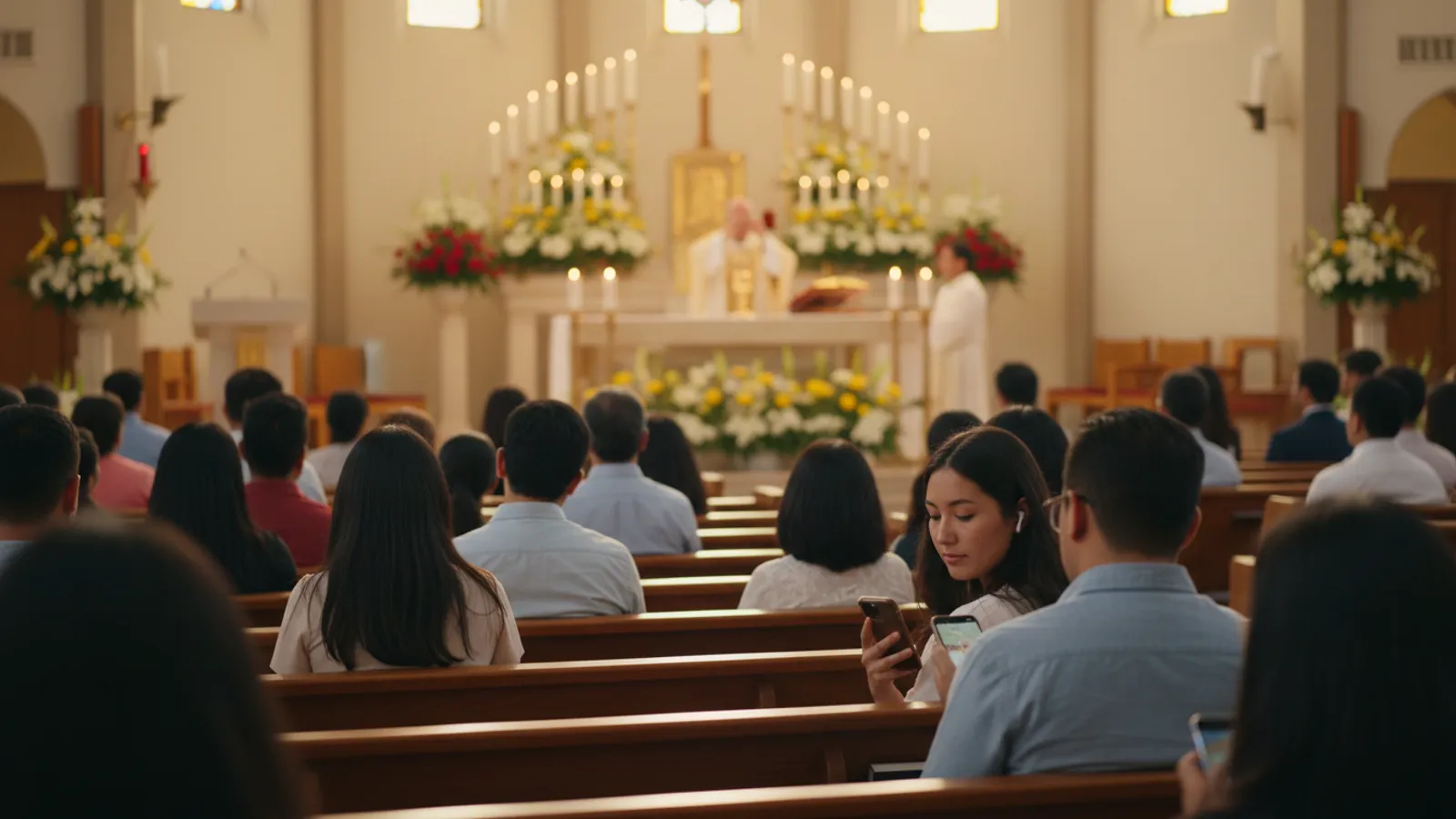
Most parishes that serve two language communities end up with two Masses: the English Mass at nine, the Spanish Mass at eleven. It works, but the two communities can go years without praying in the same room. Then a feast day comes, or Holy Thursday, or a parish anniversary, and someone asks: why don't we celebrate together?
That is the bilingual Mass: one celebration, two languages, one parish. Done well, it is one of the most moving liturgies of the year. Done in a hurry, it is a long Mass where each half of the church waits through the parts it does not understand.
This guide is for the priests, liturgy coordinators and music directors who plan it.
What is a bilingual Mass?
A bilingual Mass is a single celebration of the Eucharist in which two languages are used for different parts of the liturgy. The Order of Mass stays the same. What changes is who hears what in which language.
There is no single correct pattern. The goal is always the same: everyone present can pray the Mass, not just watch it.
Common occasions are Holy Thursday, the Easter Vigil, the parish feast day, Confirmation, and weddings and funerals for families that live in two languages. Some parishes also hold a monthly "united" Mass.
How to divide the parts of the Mass
The simplest way to plan is to sort the Mass into three kinds of parts.
Parts the people already know by heart
The Gloria, the Creed, the Our Father, the Holy Holy, the Lamb of God and the responses. People pray these from memory, so each person can pray in their own language at the same time. A low murmur of two languages during the Our Father is not a problem. Many parishes find it the most beautiful moment of the bilingual Mass.
Put both texts side by side in the worship aid for the people who want them.
Parts that change every week
The readings, the psalm, the prayers of the faithful. A common pattern:
- First reading in one language, second reading in the other, with the full text of both in the worship aid
- Responsorial psalm with a bilingual refrain, or verses alternating between languages
- Gospel proclaimed in one language, then the other (or the deacon proclaims in one and a lector in the other)
- Prayers of the faithful alternating, one intention per language, with a response everyone can say
Print the readings in both languages. If people can follow the text of the reading not being proclaimed in their language, the alternation works. If they cannot, half the church is lost for half the Liturgy of the Word.
The homily
This is where most bilingual Masses struggle, and it deserves its own section.
The homily problem
The homily is never printed in advance, it is the longest unscripted part of the Mass, and it is the part where people most want to understand every word. The usual choices:
Preach twice. The homilist gives the homily in one language, then again in the other. Everyone hears it fully, but the Mass gets longer and each community sits through a homily it does not understand. Many preachers end up giving a shorter second version, and the second community notices.
Alternate paragraph by paragraph. Smoother to listen to, but demanding to prepare and to preach, and it only works with a homilist who is truly fluent in both languages.
Preach once, interpret live. The homilist preaches once, in the language they are most comfortable in, and the other community follows through an interpreter.
The last option is the one that keeps the Mass at a normal length. Until recently it meant finding a bilingual parishioner who could interpret a homily live, plus receivers and headsets. Today it can also mean live interpretation on people's phones.
Live interpretation for a bilingual Mass
This is what Heartongue does. A laptop at the sound desk takes the audio from your mixer. Parishioners scan a QR code printed in the worship aid, choose their language, and follow on their own phone with captions and a natural AI voice, about two seconds after each sentence. No app to install and no receivers to hand out.
For a bilingual Mass this changes the planning in a few ways:
- The homily can be given once. The priest preaches in Spanish, and English speakers follow live on their phones, or the other way around.
- The switching is handled. Heartongue detects the language of every sentence. When the Gospel is proclaimed in English and then in Spanish, or the homilist moves between languages, each listener keeps following in their own language.
- A third community is not left out. The same broadcast serves several languages at once, from 49. If a few Vietnamese or Filipino families come to the parish feast day, they can follow too, without a third language in the liturgy.
- The hall can see it. A presenter screen can show the captions in an overflow space or the parish hall.
It is machine interpretation and it is not perfect: a name can come out wrong, and poor audio makes everything harder. For confession or pastoral care, a person who speaks the language is the right answer.
Why the wording matters at Mass
A generic translation app pointed at the ambo translates word for word, makes up its own Bible wording and mixes Catholic and Protestant vocabulary. At Mass, people notice immediately.
Heartongue translates the way Catholics pray. When the congregation prays the Glory Be, each listener reads the prayer as it is prayed in their own language:
English: "Glory be to the Father, and to the Son, and to the Holy Spirit."
Spanish: "Gloria al Padre, y al Hijo, y al Espíritu Santo."
Vietnamese: "Sáng danh Đức Chúa Cha, và Đức Chúa Con, và Đức Chúa Thánh Thần."
The same goes for the Our Father, the Hail Mary and the Creeds.
When the homilist quotes Scripture, listeners read the verse from a Bible in their own language and tradition, marked 📖 with the reference. Psalm 117, a fitting psalm for a parish of many nations:
English (World English Bible, Catholic edition): "Praise the LORD, all you nations! Extol him, all you peoples!"
Spanish (Santa Biblia libre para el mundo): "¡Alabad a Yahvé, todas las naciones! ¡Exaltadle, todos los pueblos!"
One honest limit: the readings at Mass come from the Lectionary, whose translations are licensed editions that Heartongue does not include. Quoted verses appear in the wording of a free Bible in the listener's language, which can differ slightly from the Lectionary. Heartongue ships 37 free, public-domain or openly licensed Bibles.
Catholic listeners also get Catholic words: la Eucaristía, not la Santa Cena; in Vietnamese, Thiên Chúa, not Đức Chúa Trời. Your team can add the names of your pastor, your parish and your saints to a glossary, even during Mass. And the announcements about the parish picnic stay everyday speech, not Scripture.
A planning checklist
- Decide the pattern early. Which readings in which language, how the Gospel and the homily will work. Share it with the priest, lectors and musicians two weeks ahead.
- Choose bilingual music. Songs both communities know, or songs with verses in each language.
- Build the worship aid. Readings in both languages, the responses side by side, and the QR code for live interpretation on the first page.
- Prepare the lectors. Each reads in their strongest language. Rehearse the alternation once.
- Test the sound. Take a line out of the mixer for the interpretation laptop. Clean audio matters most.
- Say it once at the start. "If you would like to follow the homily in English, scan the code on the first page of your booklet."
- Ask afterwards. Ask two or three people from each community what worked. Add the names and terms that came out wrong to the glossary.
What it costs
Heartongue counts language-hours: one hour of broadcasting translated into one language that someone is actually listening to. A ninety-minute bilingual Mass followed in English and Spanish uses three language-hours. Languages nobody listens to are not charged.
Every parish starts with 2 free language-hours. After that it is $4 per language-hour, or the Parish plan at $149 a month: every Mass in every language your parishioners need, without counting hours. The details are on the pricing page.
Start with the next feast day
A bilingual Mass does not have to be perfect the first time. Pick the next feast day, plan the readings and music with both communities, and try live interpretation for the homily. Then listen to what the families in the pews tell you.
See how Heartongue handles Spanish translation for church, or read our guide to a Catholic Mass in Spanish with English translation.
More from the blog
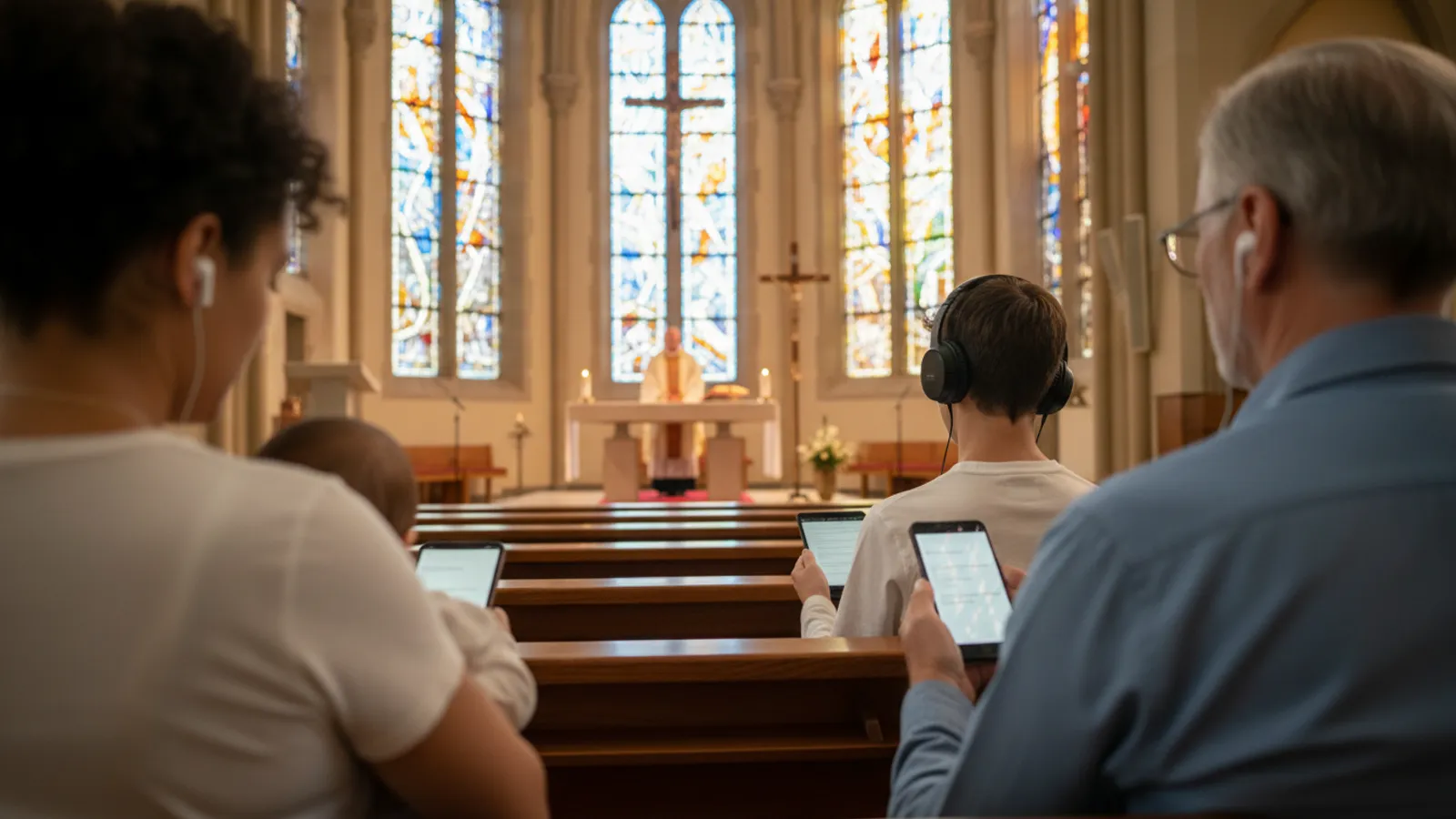
Catholic Mass in Spanish With English Translation
Heartongue8 min read
How a parish can offer English translation at its Spanish Mass, or Spanish at its English Mass, so mixed families can pray together.
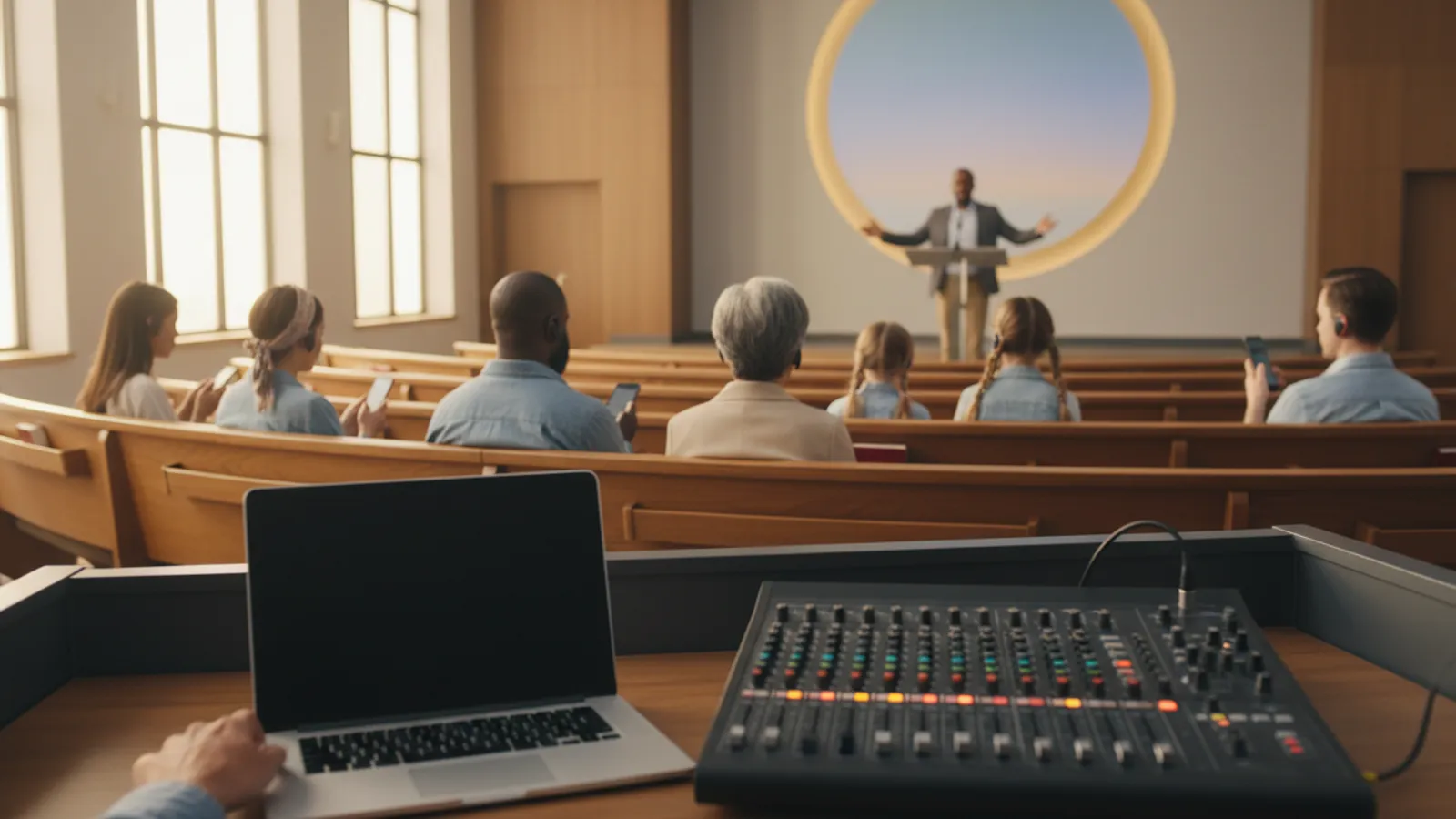
How to Choose the Best Church Translation System
Heartongue7 min read
There is no single best church translation system, only the best fit for your people. Seven questions to compare interpreters, receivers and phone-based AI.
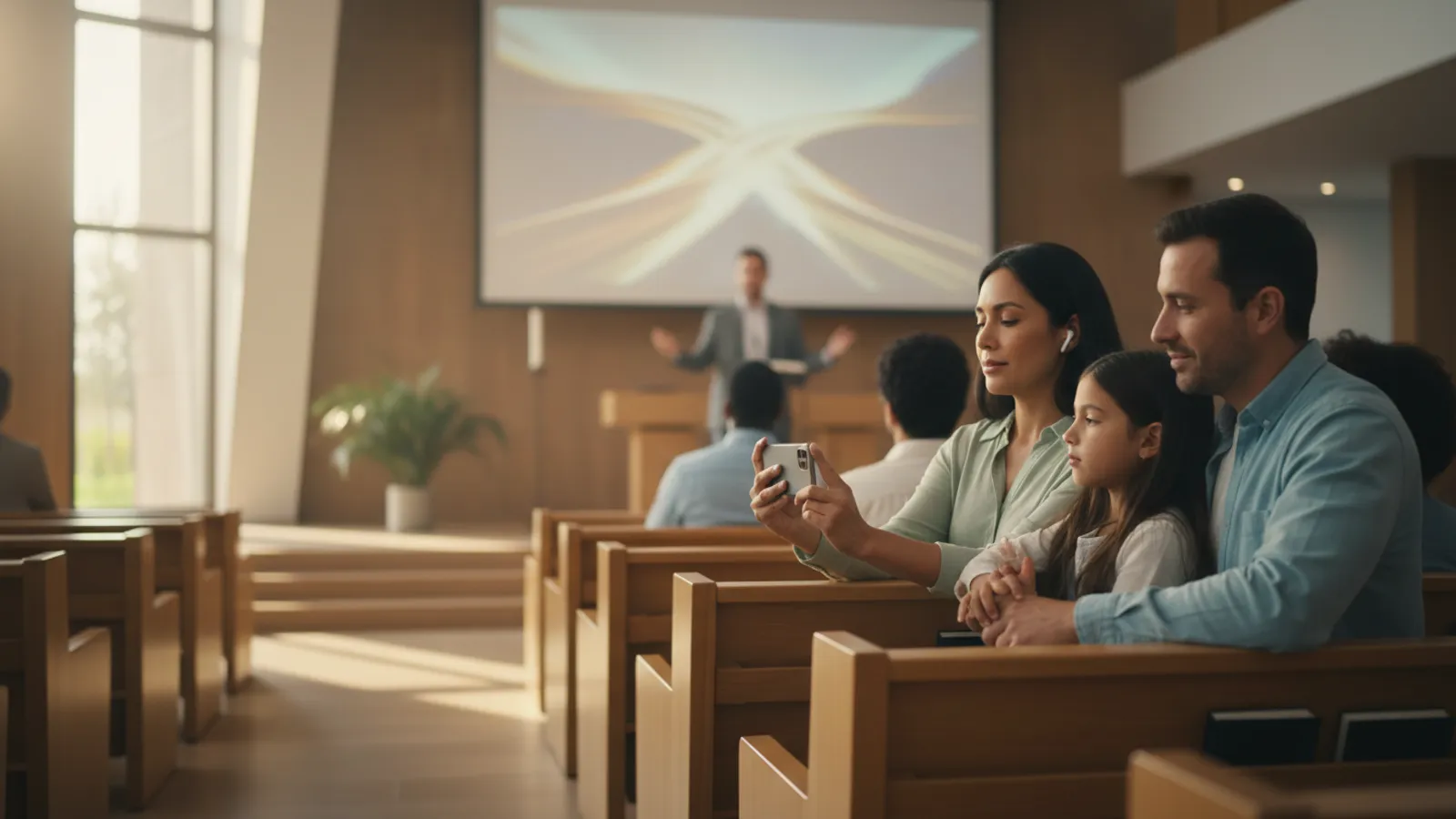
How to Add Spanish Translation to an English Service
Heartongue8 min read
Four practical ways to add Spanish translation to an English church service, what each takes on a Sunday, and a step-by-step plan to start next week.
Try it at your next service
2 language-hours free, no card needed. Set up a room in five minutes.