
Funeral Mass in Spanish: Planning for a Bilingual Family
How a parish plans a funeral Mass in Spanish or for Spanish- and English-speaking relatives: readings, homily, words of remembrance, interpretation.
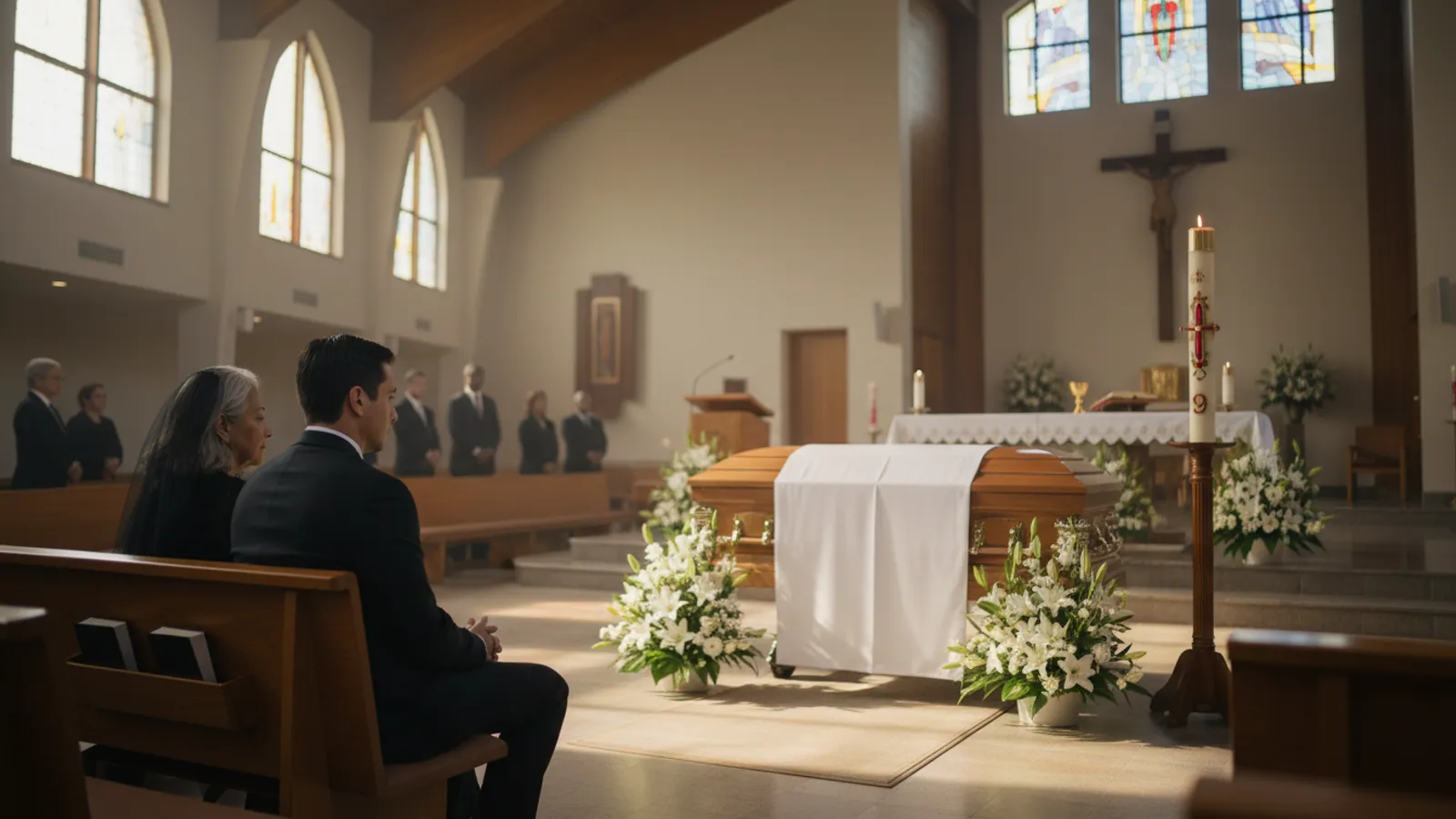
A funeral is the parish service with the least time to plan. The family calls on a Monday, the Mass is on Friday, and somewhere in the first conversation someone says: "Mamá only understood Spanish, but half the grandchildren don't speak it."
This guide is for the pastors, deacons, bereavement ministers and parish office staff who hear that sentence: a funeral Mass in Spanish, a bilingual funeral Mass, and how every relative can follow.
The words families will use
Spanish-speaking families may not say "funeral Mass" when they call. Knowing their words saves a confused phone call:
- Misa de exequias or misa de funeral: the funeral Mass.
- Misa de cuerpo presente: the funeral Mass with the body present, as opposed to a memorial Mass later.
- Velorio: the vigil or wake, often at the funeral home, sometimes with a rosary.
- Novenario: nine days of rosaries after the death, in many Mexican and Central American families, at home or in the church. The family may ask for a Mass on the ninth day too.
- Misa de difuntos or misa por el eterno descanso: a Mass offered for the dead, for example on the anniversary.
Ask early how many relatives speak only Spanish and how many only English; it shapes everything below.
A Mass in Spanish, or a bilingual Mass?
A funeral Mass in Spanish. If most mourners pray in Spanish and a Spanish-speaking priest or deacon is free, celebrate it in Spanish. The family hears the prayers they know. The English-speaking grandchildren and in-laws still need a way to follow.
A bilingual funeral Mass. When the family is split, many parishes divide the Mass between the two languages.
A funeral Mass in English for a Spanish-speaking family. Sometimes no Spanish-speaking priest is free that week. The older relatives then need a way to follow in Spanish.
Dividing the funeral Mass between two languages
The family chooses the readings from the options in the Order of Christian Funerals (in Spanish, the Ritual de exequias). A simple bilingual pattern:
- First reading in Spanish, read by a relative who is comfortable reading aloud in it.
- Second reading in English, read by a grandchild or friend.
- Psalm with a bilingual refrain, verses alternating. Psalm 23 is a common choice and many families know it in both languages.
- Gospel in one language; once is often enough if everyone can follow it on paper or on their phone.
- Prayers of the faithful alternating, one intention per language, with a response everyone can say.
- The Our Father prayed by each person in their own language at the same time.
Music matters a great deal at funerals. Ask about the songs the deceased loved. Many Hispanic families expect particular cantos at the final commendation; let the Spanish choir or a cantor lead those.
The homily and the words of remembrance
The readings can be printed and the prayers are known by heart. The homily cannot be printed, and it is the part grieving families most want to understand: what the priest says about their mother, about death and about the resurrection.
The usual choices are preaching twice (long for a tired family), switching languages paragraph by paragraph (only for a truly bilingual homilist), or one homily with interpretation.
If your diocese allows words of remembrance, a relative often speaks in whichever language they are most at ease in, which may not be the language of half the room. Interpretation helps here too.
Asking a grieving bilingual relative to interpret is hard: they should be sitting with their family.
Live interpretation on mourners' phones
This is what Heartongue does. A laptop at the sound desk takes the audio from your sound system. Mourners scan a QR code printed in the worship aid, choose their language, and follow the Mass on their own phone with captions and a natural AI voice, about two seconds after each sentence. Nothing to install and no receivers to hand out at the door.
For a funeral Mass that means:
- The homily is given once. The priest preaches in Spanish and the English-speaking grandchildren follow on their phones, or the other way around.
- Language changes are followed. Heartongue detects the language of every sentence, so when the first reading is in Spanish and the second in English, each mourner keeps following in their own language.
- Words of remembrance reach everyone. When the eldest son speaks in English, his aunts can follow in Spanish.
- Other relatives are included. One broadcast serves several languages at once, from 49.
It is machine interpretation and it is not perfect. A name can come out wrong, and a weak microphone or a crying room makes everything harder. Because funerals come with little warning, set it up once at an ordinary Spanish Mass, so that on the day you only need to start the broadcast.
The readings as the family's Bible has them
A generic translation app translates word for word and invents its own Bible wording. At a funeral, where people listen to every line, that is painful to read.
Heartongue translates the way your parish speaks. When a reading or a quoted verse is recognized, each listener reads it from a Bible in their own language and tradition, marked 📖 with the reference. A funeral favorite comes from the Book of Wisdom, which is in Catholic Bibles but not in Protestant ones. Wisdom 3:1:
English (World English Bible, Catholic edition): "But the souls of the righteous are in the hand of God, and no torment will touch them."
Spanish (Santa Biblia libre para el mundo): "Pero las almas de los justos están en la mano de Dios, y ningún tormento les tocará."
And from the Gospel of the raising of Lazarus, John 11:25:
English: "I am the resurrection and the life. He who believes in me will still live, even if he dies."
Spanish: "Yo soy la resurrección y la vida. El que cree en mí seguirá viviendo, aunque muera."
One honest limit: the readings at Mass come from the Lectionary, and its translations are licensed editions that Heartongue does not include. Quoted verses appear in the wording of one of 37 free, public-domain or openly licensed Bibles, which can differ slightly from what the lector reads.
Catholic listeners hear Catholic words: la Eucaristía, not la Santa Cena. When the congregation prays the Our Father or the Hail Mary, each listener reads it as Catholics pray it in their own language. And when the funeral director announces the procession to the cemetery and the reception in the parish hall, that stays plain speech.
Before the funeral, add the name of the deceased, the family's names and the cemetery to the glossary. Your team can also fix a term during the Mass.
A checklist for the parish office
- Ask about languages in the first call. Who speaks only Spanish, who only English, who will read and who will speak.
- Choose the pattern with the family. Which reading in which language, who preaches, whether there are words of remembrance and in which language.
- Build a short worship aid. The readings in both languages, the responses side by side, and the QR code for live interpretation on the first page.
- Brief the priest or deacon. Speak close to the microphone, pause between sentences, and mention once at the start that mourners can follow in Spanish or in English on their phones.
- Prepare the setup in advance. Test live interpretation at an ordinary Spanish Mass, so that a funeral only needs the room started and the names in the glossary.
What it costs
Heartongue counts language-hours: one hour of broadcasting translated into one language that someone is actually listening to. A one-hour funeral Mass in Spanish followed by relatives in English uses about one language-hour. Languages nobody listens to are not charged.
Every parish starts with 2 free language-hours, enough for a funeral Mass or a test at Sunday Mass. After that it is $4 per language-hour, the Chapel plan at $49 a month with 15 hours, or the Parish plan at $149 a month for every Mass in every language your parishioners need. The details are on the pricing page.
One Mass, the whole family
A funeral Mass is the parish's last gift to a family. When the grandmother prayed in Spanish and her grandchildren pray in English, both deserve to hear the homily, the readings and the prayers of commendation in words they understand. A few decisions in the first phone call and a tested setup make that possible even with four days' notice.
See how Heartongue handles Spanish translation for church, or read our guides to the bilingual Mass and the Catholic Mass in Spanish with English translation.
More from the blog
Midnight Mass in Spanish: Planning a Bilingual Christmas Eve
Heartongue8 min read
How a parish plans Midnight Mass in Spanish, or one Christmas Mass for Spanish- and English-speaking families: readings, music, homily, interpretation.
Church Translation App: How to Test One Before Sunday
Heartongue7 min read
A church translation app can sound fine in a demo and fail at Mass. Five tests for a weeknight: a Bible verse, a prayer, church words, an idiom, announcements.
Church Services in Portuguese: Live Translation Guide
Heartongue7 min read
How parishes and churches offer Mass or a Sunday service in Portuguese, live on phones, with Catholic and Protestant wording each listener knows.
Try it at your next service
2 language-hours free, no card needed. Set up a room in five minutes.
 Product Hunt
 Indie Hackers
 Fazier
 StartupBase