
Church Services in Portuguese: Live Translation Guide
How parishes and churches offer Mass or a Sunday service in Portuguese, live on phones, with Catholic and Protestant wording each listener knows.
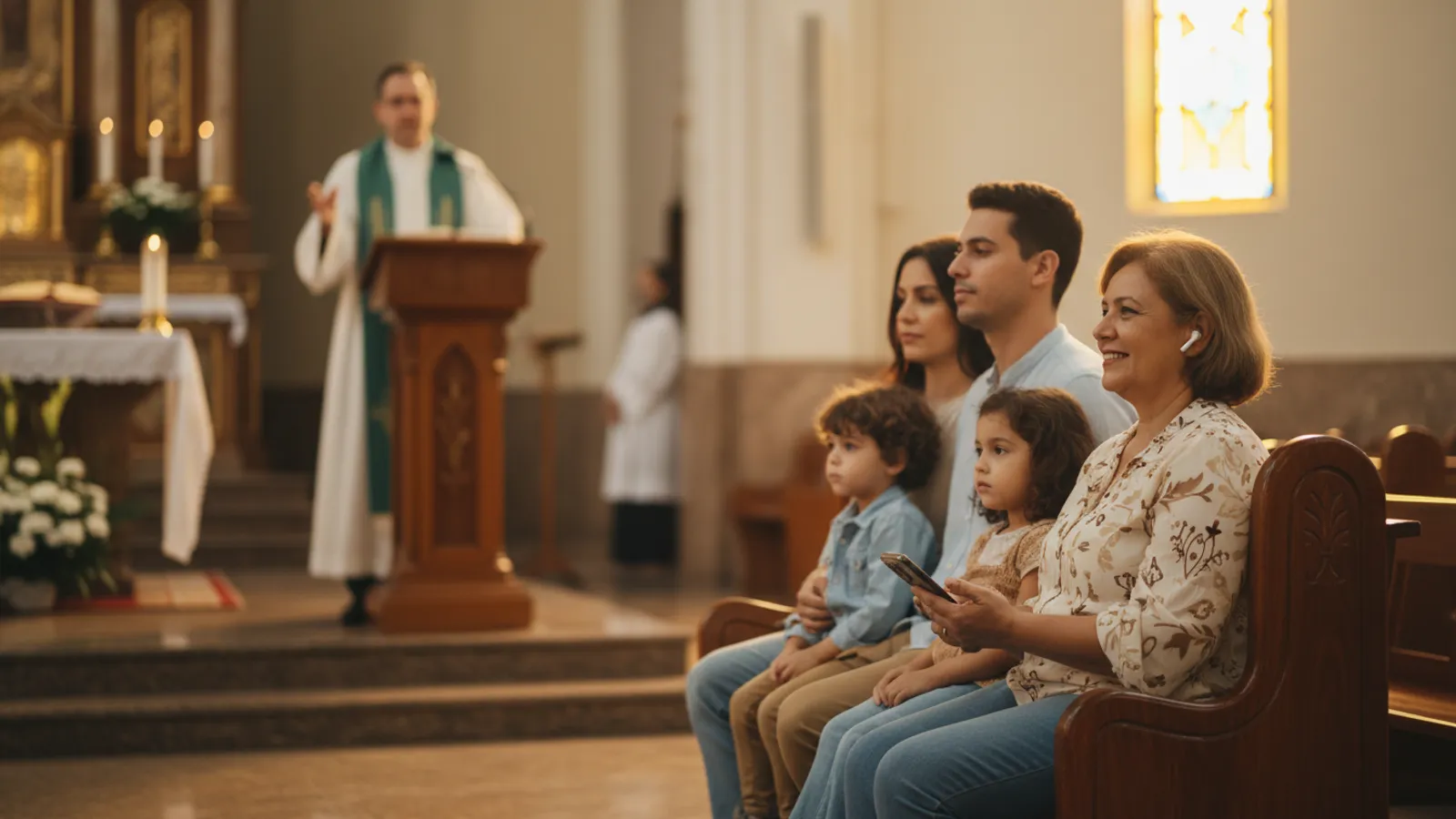
Portuguese-speaking families turn up in English-speaking parishes and churches all the time. A Brazilian couple moves to town for work. A grandmother from the Azores comes to stay for the winter. A Cape Verdean family joins after a funeral or a wedding. They want to worship with the community, and they want to understand the homily.
Most churches cannot start a Portuguese Mass or service for a handful of families. What they can do is offer the service they already have in Portuguese, live, on the phones people already carry. This guide covers the usual options, what makes church Portuguese tricky to translate, and how to set it up for a Sunday.
Who is in the pews
Portuguese speakers are not one community, and it helps to know who you are serving before you choose a setup.
- Brazilian families. The largest group in most English-speaking countries. Many are Catholic, and many belong to evangelical churches, so the same parish may welcome both.
- Portuguese and Azorean families. Often long-established, often Catholic, with older members who prefer Portuguese for prayer.
- Families from Angola, Mozambique and Cape Verde. Portuguese is the language of the liturgy at home for many of them, even when another language is spoken in the family.
There is also the other direction. A Portuguese-language Mass or service may have spouses, young people or visiting clergy who follow better in English. A good setup handles both without changing anything between services.
The usual options
A bilingual member who interprets
Someone fluent in both languages interprets the homily, either from the front after each paragraph or quietly into a transmitter for listeners with headsets. It works when that person is available. It depends on them every week, interpreting a 20-minute homily is tiring, and church vocabulary is a specialist skill even for fluent speakers.
A Portuguese Mass or service
Parishes with a large Brazilian or Portuguese community often have a Portuguese Mass with a Portuguese-speaking priest. It is the best answer for the community that has one. It does not help the family of four in a parish without one, or mixed families who want to sit together at the English Mass.
Printed readings and outlines
Readings and a homily outline can be printed in both languages. That covers what is known in advance and misses what the priest or pastor says on the day.
Live AI interpretation on phones
A laptop at the sound desk takes the feed from the mixer. Each sentence is interpreted as it is spoken and reaches listeners' phones as captions and a natural voice, about two seconds after the speaker finishes it. Listeners scan a QR code, choose Português, and put in their earphones. With Heartongue the speaker can switch between English and Portuguese during the service, and each sentence's language is detected on its own.
It is machine interpretation, so it can stumble on unusual names or a noisy feed. That is why the team can fix names and terms in a glossary while the service is live.
Why church Portuguese is hard to translate
General translation tools handle everyday Portuguese well. Church Portuguese is harder, because Catholics and Protestants use different words, and a Brazilian Catholic notices at once when a translation sounds like the evangelical church down the road (and the other way round).
| English | Catholic Portuguese | Protestant Portuguese |
|---|---|---|
| The Eucharist / Communion | Eucaristia | Santa Ceia |
| The priest / the pastor | o Padre | o Pastor |
| Our Father, who art in heaven | Pai nosso, que estais nos céus | Pai nosso, que estás nos céus |
Heartongue knows which tradition each congregation belongs to and uses its words, from a list of more than 1,000 church terms in every language.
Prayers as the parish prays them
The last row of that table matters more than it looks. When the priest leads the Our Father in English, a generic tool translates the English line by line, and the result is a prayer nobody has ever prayed. A Brazilian Catholic prays "santificado seja o vosso nome", addressing God as "vós". A Brazilian evangelical prays "santificado seja o teu nome". One small pronoun decides whether the prayer sounds like home.
Heartongue gives each congregation its own wording for the Our Father, the Hail Mary ("Ave Maria, cheia de graça, o Senhor é convosco…"), the Creeds and the Glory Be, so Portuguese-speaking listeners can pray along in the words they learned as children.
Bible verses from a real Portuguese Bible
When the preacher reads a verse, listeners should read a Portuguese Bible, not a paraphrase made up on the spot. Here is Matthew 5:9 from the World English Bible (Catholic edition):
Blessed are the peacemakers, for they shall be called children of God.
A Catholic listener following in Portuguese reads it from the Bíblia Portuguesa Mundial, marked 📖 with the reference:
Bem-aventurados os pacificadores, pois eles serão chamados filhos de Deus. (Mateus 5:9)
A Protestant listener reads it from the Bíblia Livre:
Benditos são os pacíficos, porque eles serão chamados filhos de Deus. (Mateus 5:9)
Same verse, two Bibles, each one recognisable to the people who read it. When the preacher quotes only part of a verse, the wording still follows that Bible.
One honest note: Heartongue includes only free, public-domain or openly licensed Bibles, and both Portuguese ones are in Brazilian Portuguese. The Bibles printed in Catholic missals and the popular evangelical editions are under copyright and are not included. For a parish, the prayers and Catholic church words above carry most of the weight.
Natural phrasing, not word for word
Homilies are full of everyday English. "Let's not beat around the bush" translated word for word becomes something about hitting a bush, which means nothing in Portuguese. Translated by meaning, it becomes "vamos direto ao ponto". Good interpretation keeps sentences whole, translates idioms by meaning, and keeps announcements and personal stories in plain everyday Portuguese, with no Bible voice where there is none.
Setting it up for a Sunday
- Create the parish or church in the app and a room for the service. Every room offers all 49 languages, Portuguese and English included, with nothing to configure.
- Connect the sound desk. A line from the mixer into a laptop gives much cleaner audio than a microphone in the room.
- Add your names to the glossary. Your priest's or pastor's name, the patron saint, ministry names and any Brazilian or Portuguese place names your community uses. Five minutes here saves a lot of confusion.
- Print the QR code once. Each room keeps the same QR code and link, so it can go on a card in the pews or in the bulletin every week.
- Tell people in their own language. One line in the bulletin is enough: "Escaneie o código QR, escolha Português e ouça a homilia no seu celular." Listeners need no app and no account.
For older listeners, show them the A+ button to enlarge captions and the contrast button for yellow text on black. The phone remembers both for next week. Ask everyone to use earphones so the room stays quiet.
Ask one family for feedback
Before you rely on it, ask one Portuguese-speaking family to follow the homily for a few Sundays and tell you what sounds wrong. They will notice a saint's name or a Brazilian expression long before anyone else, and every fix goes into the glossary for good. If your community mixes Brazilian and European Portuguese speakers, ask one of each.
Try it at a real Mass
Heartongue gives every new church and parish 2 free language-hours to try it at a real service, with no card. After that, the Chapel plan is $49 a month for 15 language-hours, and the Parish plan at $149 a month covers every regular service in every language. See how Portuguese translation for church works, or read how parishes plan a bilingual Mass.
More from the blog
Funeral Mass in Spanish: Planning for a Bilingual Family
Heartongue8 min read
How a parish plans a funeral Mass in Spanish or for Spanish- and English-speaking relatives: readings, homily, words of remembrance, interpretation.
Midnight Mass in Spanish: Planning a Bilingual Christmas Eve
Heartongue8 min read
How a parish plans Midnight Mass in Spanish, or one Christmas Mass for Spanish- and English-speaking families: readings, music, homily, interpretation.
Church Translation App: How to Test One Before Sunday
Heartongue7 min read
A church translation app can sound fine in a demo and fail at Mass. Five tests for a weeknight: a Bible verse, a prayer, church words, an idiom, announcements.
Try it at your next service
2 language-hours free, no card needed. Set up a room in five minutes.
 Product Hunt
 Indie Hackers
 Fazier
 StartupBase