
Sermon Translation: Live Options for Churches and Parishes
How to translate a sermon or homily live so every language group can follow: volunteer interpreters, printed notes, captions and AI interpretation on phones.
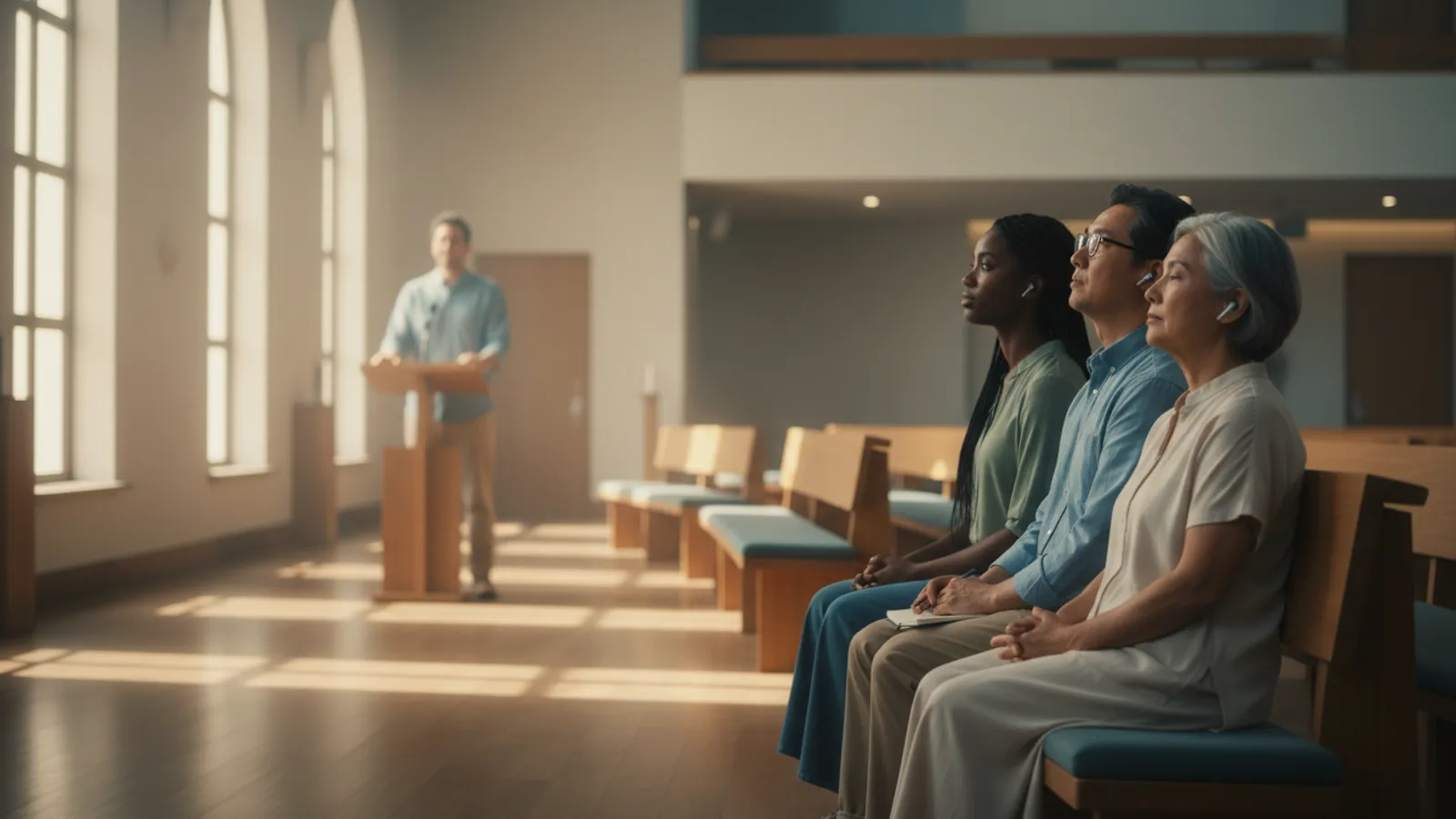
The readings can be printed. The hymns can go on the screen in two languages. The sermon is the hard part. It is written the night before (or not written at all), it changes as the preacher reads the room, and it is the part of the service where people most need to understand every sentence. That is why "sermon translation" is usually the first problem a multilingual church or parish tries to solve.
This guide walks through the ways churches translate a sermon or homily today, what each one asks of your team on a Sunday, and what makes a translation easy to follow instead of tiring.
Four ways to translate a sermon
1. A volunteer interpreter
Someone bilingual stands next to the preacher and repeats each paragraph in the other language (consecutive), or sits at the back and speaks into a transmitter while listeners wear headsets (simultaneous).
Consecutive interpretation is simple and warm, and it works well for two languages in a small room. It also doubles the length of the sermon, and many preachers find it hard to keep their rhythm. Simultaneous interpretation keeps the timing but needs equipment and a skilled interpreter, someone who can listen and speak at the same time for twenty or thirty minutes. Most churches have one such person at best, and that person also needs Sundays off.
2. Printed or projected notes
The preacher sends an outline or a full text on Friday, a volunteer translates it, and the translation is handed out or projected.
This is good for the main points and the Scripture references. It misses what the preacher adds on the day: the story about the youth retreat, the answer to something that happened that week, the line that makes everyone laugh. Listeners end up reading a different sermon from the one they hear.
3. Recorded and translated later
Some churches record the sermon and publish a translated version during the week. It helps people who want to go deeper, and it is a reasonable first step for a church with no interpreter. But it does not help the family sitting in the pews on Sunday morning, which is usually the whole point.
4. Live AI interpretation on phones
The preacher's microphone feeds a laptop at the sound desk. Each sentence is translated as it is spoken and reaches listeners' phones as captions and a natural voice. Listeners scan a QR code, pick their language and put in their own earphones. Several language groups can follow the same sermon at once, each in their own language.
With Heartongue, each sentence arrives about two seconds after the preacher finishes it. It is not a human interpreter: it can stumble on unusual names or a noisy feed, which is why it lets your team fix church words in a glossary while the service is live.
What makes a sermon translation easy to follow
A sermon is not a business meeting, and translating it word for word gives listeners something they can technically understand but have to work hard to follow. Three things make the difference.
Bible verses from the listener's own Bible
When the preacher reads a verse, listeners should not hear a fresh paraphrase made up on the spot. They should hear the verse as their own Bible says it, the wording they may know by heart.
Take Matthew 11:28, read in English from the World English Bible (Catholic edition):
"Come to me, all you who labor and are heavily burdened, and I will give you rest."
With Heartongue, a Catholic listener following in Spanish reads it from the Santa Biblia libre para el mundo:
«Venid a mí todos los que estáis fatigados y agobiados, y yo os haré descansar.» (Mateo 11:28)
A Protestant listener following in Spanish reads it from the Reina-Valera 1909:
Venid á mí todos los que estáis trabajados y cargados, que yo os haré descansar. (Mateo 11:28)
A Vietnamese listener reads it from the 1934 Vietnamese Bible:
Hỡi những kẻ mệt mỏi và gánh nặng, hãy đến cùng ta, ta sẽ cho các ngươi được yên nghỉ. (Ma-thi-ơ 11:28)
Each verse is marked 📖 with its reference, so listeners can find it in their own Bible later. When the preacher quotes only half a verse, the wording still follows that Bible.
Church words by tradition
Catholic and Protestant communities often use different words for the same thing, and listeners notice at once when a translation mixes them up. In Vietnamese, Catholics say "Thiên Chúa" where many Protestants say "Đức Chúa Trời", and the apostle John is "Gioan" for one and "Giăng" for the other. In Korean, it is 하느님 for Catholics and 하나님 for most Protestants.
Heartongue knows which tradition each congregation belongs to and uses its words, from a list of more than 1,000 church terms in every language. For a parish, that matters as much in the homily as in the readings: when the priest quotes the Our Father or the Hail Mary, listeners hear the prayer in the words their parish prays, not a new translation of the English.
Natural phrasing, not word for word
Preachers talk the way people talk. A line like "Some of you came in this morning running on empty" translated word for word into Spanish becomes "Algunos de ustedes entraron esta mañana corriendo en vacío", which sounds like a car problem. Translated by meaning, it becomes something like "Algunos de ustedes llegaron hoy sin fuerzas", which is what the preacher meant.
The same goes for "born again", "let's open our Bibles", "the closing song" and the many expressions every church has. Good sermon translation keeps sentences whole, translates idioms by meaning, and keeps everyday parts (the announcements, the story about the preacher's grandmother) in everyday language rather than a solemn Bible voice.
Practical tips for any method
- Feed clean audio. Whether a person or a machine is translating, a direct line from the mixer beats a microphone at the back of the room.
- Share the references early. Send the Bible references and any names (guest speakers, ministries, places) to your interpreter or put them in the glossary before Sunday.
- Pause a little after a reading. A short breath after a verse helps every listener, whatever the method.
- Tell people once, clearly. One line in the bulletin and on the screen before the sermon, with the QR code: "Scan to follow the sermon in your language."
- Ask a real listener. Have one member of each language group follow for a few weeks and tell you what sounds wrong. Their notes are worth more than any test.
Which option fits your church?
- One small language group and a gifted bilingual member: consecutive interpretation may be all you need.
- A weekly interpreter you can rely on: simultaneous interpretation with receivers works well, especially for events where every word has to be exact.
- Several language groups, no interpreter every week, or a parish with Masses for different communities: live AI interpretation on phones lets each listener follow the homily in their own language without a booth or a receiver desk.
Many churches combine them: AI interpretation for regular services, a human interpreter for weddings, funerals and special events.
Try it at a real service
Heartongue gives every new church and parish 2 free language-hours to try sermon translation at a real service, then plans start at $49 a month. See how it works for Spanish, Vietnamese, Korean and Chinese congregations, or read how a church translation system without receivers is set up.
More from the blog
Bilingual Mass: How to Plan One Your Parish Can Follow
Heartongue8 min read
A practical guide to planning a bilingual Mass for two language communities, from readings and music to the homily, with options for live interpretation.
Catholic Mass in Spanish With English Translation
Heartongue8 min read
How a parish can offer English translation at its Spanish Mass, or Spanish at its English Mass, so mixed families can pray together.
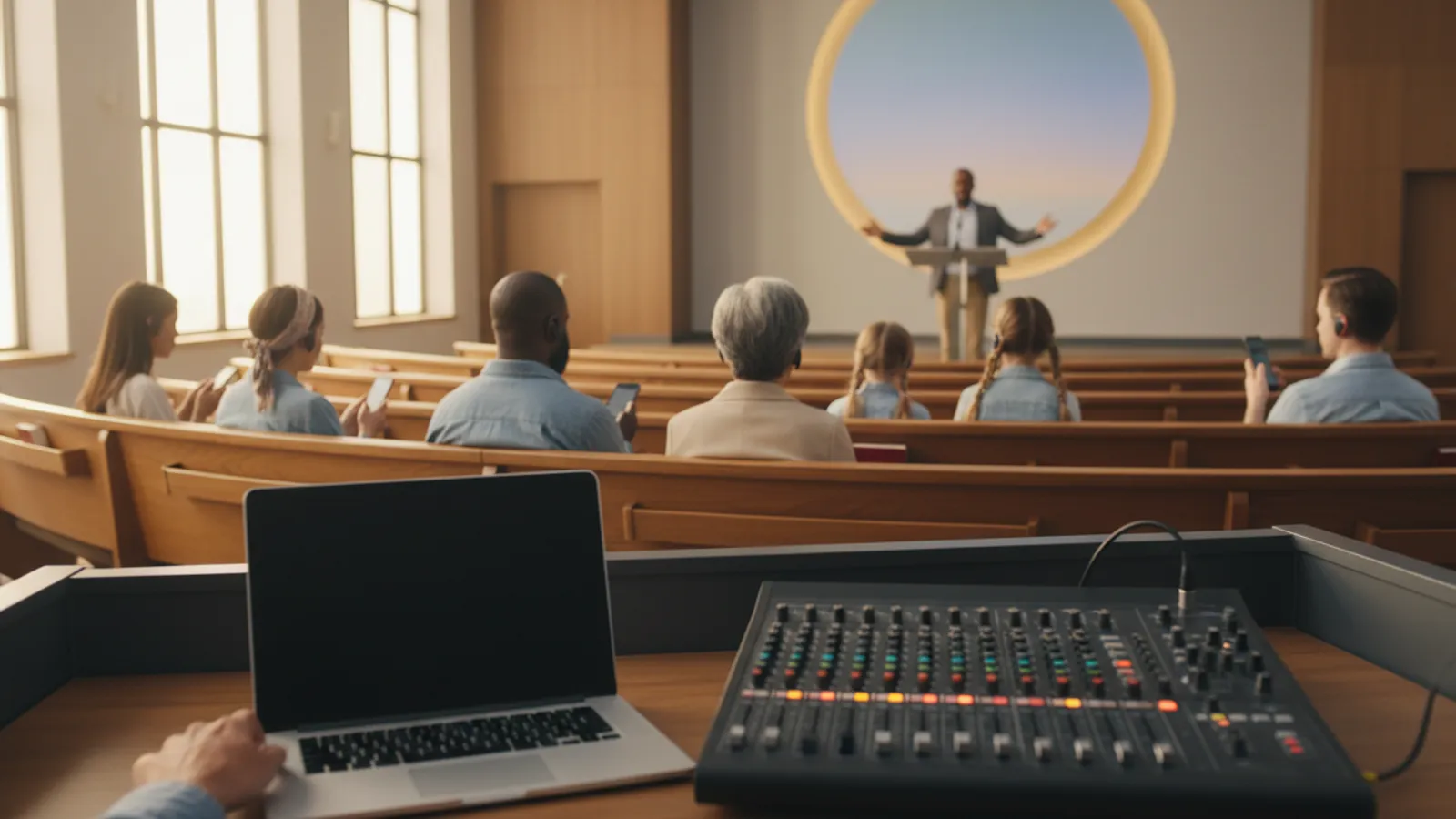
How to Choose the Best Church Translation System
Heartongue7 min read
There is no single best church translation system, only the best fit for your people. Seven questions to compare interpreters, receivers and phone-based AI.
Try it at your next service
2 language-hours free, no card needed. Set up a room in five minutes.