
How to Choose the Best Church Translation System
There is no single best church translation system, only the best fit for your people. Seven questions to compare interpreters, receivers and phone-based AI.
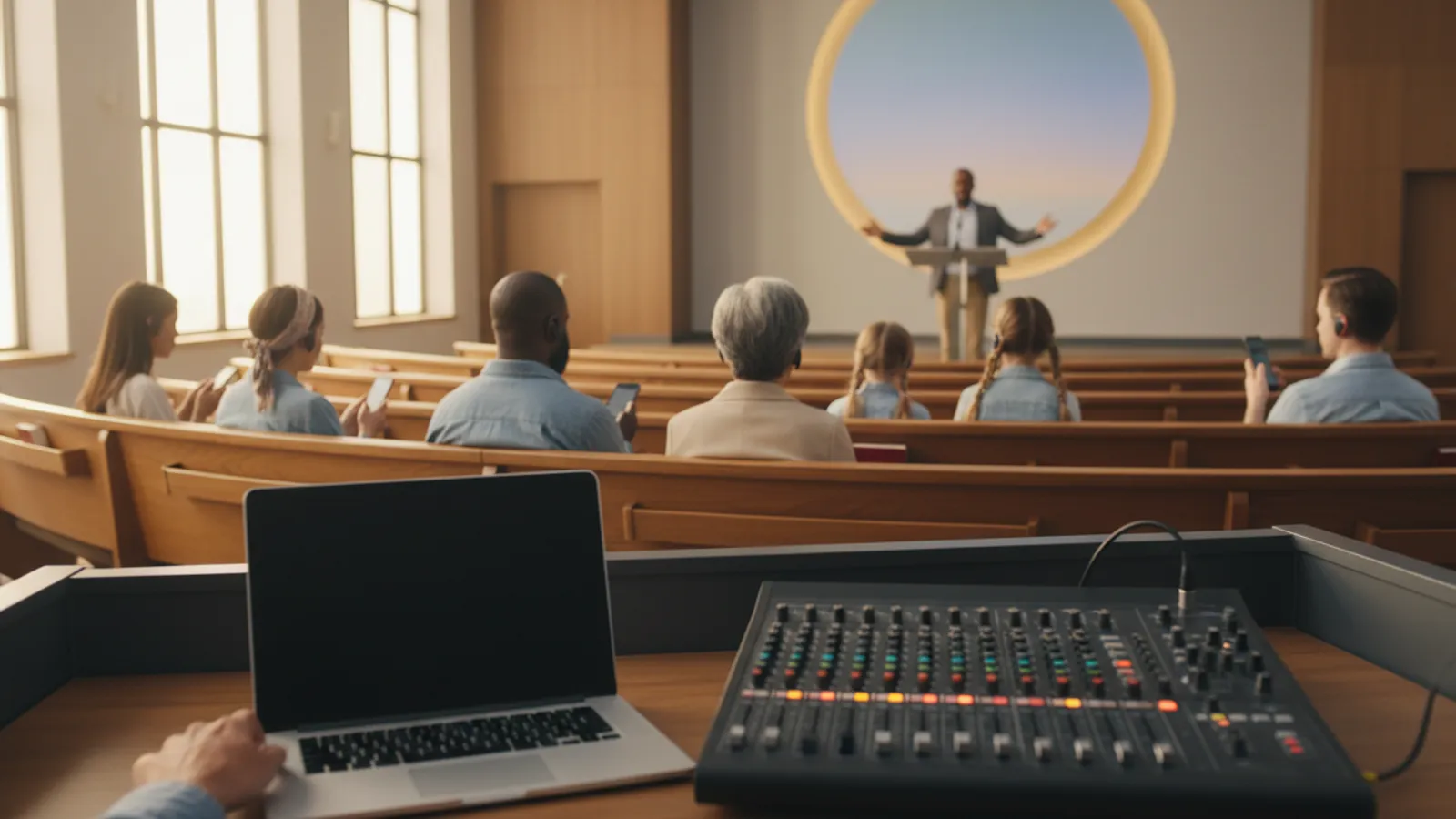
Search for the best church translation system and you will find lists of transmitters, headsets, apps and services, each one "the best". The honest answer is that there is no single best system. There is the system that fits your congregation, your volunteers and your Sunday morning, and the one that ends up in a cupboard after a month.
This guide gives you seven questions to ask before you choose, explains the three main kinds of systems in plain terms, and ends with a simple way to test one at a real service.
The three kinds of church translation systems
Almost every option falls into one of three groups.
1. A human interpreter with receivers and headsets. An interpreter listens to the sermon and speaks the translation into a microphone. A transmitter sends it over radio or infrared to small receivers, one per listener, each with a headset. This is the classic setup and it can be excellent, as long as you have a skilled interpreter every week.
2. A human interpreter with phones instead of receivers. The interpreter is still a person, but the audio goes over the internet or the church Wi-Fi to listeners' phones. You save on receivers, but you still need someone fluent at every service, for every language.
3. AI interpretation on listeners' phones. A laptop at the sound desk sends the speaker's audio to a service that translates it as it is spoken. Listeners scan a QR code, pick a language and hear a synthesized voice with captions. Heartongue is this kind of system: each sentence arrives about two seconds after the speaker finishes it.
Many churches end up combining them, for example AI interpretation for the weekly service and a human interpreter for a baptism or a membership class. You do not have to pick one forever.
Question 1: Who will run it every week?
This is the question that decides most choices, and it is the one most often skipped.
A human interpreter needs to be there every Sunday, prepared, and rested enough to interpret a 40-minute sermon. One interpreter per language. When they are sick or on holiday, the translation stops. If you already have a dependable team, that is a real strength. If you are counting on one bilingual member who "can probably do it", be careful: it is a lot to ask, week after week.
With an AI system the weekly job is smaller: someone at the sound desk starts the broadcast and keeps an eye on it. That can be the person already running sound.
Question 2: Which languages, and how many at once?
Write down the languages people in your church actually need today, not the ones you might need one day.
- One language with a strong interpreter available: a human interpreter is hard to beat.
- Two or more languages: every extra language means another interpreter and another channel with a human system. With an AI system the languages run side by side from the same broadcast.
Heartongue covers English, Spanish, Korean, Vietnamese and Chinese (Mandarin). The speaker can use any of the five, and listeners choose any of the five. If you need a language outside that list, a phone-based AI system like ours is not the right fit for that group yet, and you should say so plainly when you compare options.
Question 3: How exact does it need to be?
Be honest about the kind of speaking you are translating.
For a sermon, announcements or a testimony, the goal is that listeners follow along and feel part of the service. Good AI interpretation does that well in most cases, but it is machine interpretation: it can get names wrong, stumble over a quote, or struggle with poor audio.
For anything where every word matters, such as a legal, medical, pastoral-care or membership conversation, use a qualified human interpreter. No system that translates on the fly should be the only option there.
A good AI system lets you reduce the most common mistakes. Heartongue has a glossary where you add your pastor's name, church and ministry names, and terms you want translated the same way every time.
Question 4: What do listeners have to do?
Picture a visitor who arrives five minutes late and sits at the back.
- With receivers, someone must notice them, walk over with a receiver and show them the channel.
- With an app, they need to download it, maybe create an account, and hope the church Wi-Fi works.
- With a browser-based system, they scan a QR code from the bulletin or the screen, choose a language and tap Join.
Heartongue works in the phone's browser: no app to install and no account for listeners. Each room has a permanent QR code, so you can print it once in the bulletin and on a card at the end of each row. On iPhone, the audio keeps playing with the screen locked, which matters more than you would think during a long sermon.
Ask every vendor the same thing: how many taps from "sitting down" to "hearing the sermon"?
Question 5: What does your sound setup look like?
Every system depends on clean audio from the speaker. The best input is a line from your mixer, not a microphone picking up the room.
With receivers you need a place for the interpreter to sit where they can hear clearly without being heard by the congregation. With an AI system you need a laptop at the sound desk with a reliable internet connection. Heartongue keeps up to 30 seconds of audio if the connection drops and reconnects on its own, so a short network hiccup does not end the broadcast.
Question 6: What does it really cost?
Compare the full cost over a year, not only the price tag.
For a receiver system, add up the transmitter, receivers, headsets, batteries or charging, replacements for the ones that go missing, and the volunteer hours to hand them out and collect them. For a human interpreter, count the hours of a volunteer you could otherwise ask to serve somewhere else, or the fee if you pay a professional.
For an AI system, look at how usage is counted. Heartongue charges per language-hour: one hour of broadcasting translated into one language that someone is listening to. A one-hour service listened to in Spanish and Korean uses two language-hours. Languages nobody is listening to are not charged. There is a free trial of 2 language-hours, then $4 per language-hour, or monthly plans from $49 for 15 language-hours. All the details are on the pricing page.
Question 7: Can you try it at a real service?
A demo video tells you very little. The only test that counts is a normal Sunday, with your speaker, your sound desk and your listeners.
Whatever you are considering, ask for a way to run it at one or two real services before you commit. Then ask two or three members who speak the language to listen and tell you honestly what worked and what did not.
A simple way to decide
If you remember one thing, make it this:
- You have reliable interpreters and one language: keep or build a human interpreter system. Add receivers or phones depending on where listeners sit.
- You have no regular interpreter, or need several languages: start with AI interpretation on phones, and bring in a human interpreter for the moments where every word must be exact.
- You are not sure: run a two-week test. You will learn more from two Sundays than from any comparison chart.
Try Heartongue at your next service
Heartongue is a church translation system without receivers: a laptop at the sound desk, a QR code for listeners, and voice with captions on their own phones. Every new church gets 2 free language-hours, enough to test it at a real service. See how it works for Spanish, Korean, Vietnamese and Chinese, or read our comparison of translation equipment and phones.
More from the blog
How to Add Spanish Translation to an English Service
Heartongue8 min read
Four practical ways to add Spanish translation to an English church service, what each takes on a Sunday, and a step-by-step plan to start next week.
Church Translation Equipment vs. Phones: What a Small Church Needs
Heartongue4 min read
Transmitters, receivers and headsets, or the phones people already carry? How church translation equipment works, what it takes to run, and when each makes sense.
Try it at your next service
2 language-hours free, no card needed. Set up a room in five minutes.