
Korean and English Ministry: Live Sermon Translation
How Korean churches with an English Ministry translate the sermon live for joint services, so first and second generation can worship in one room.
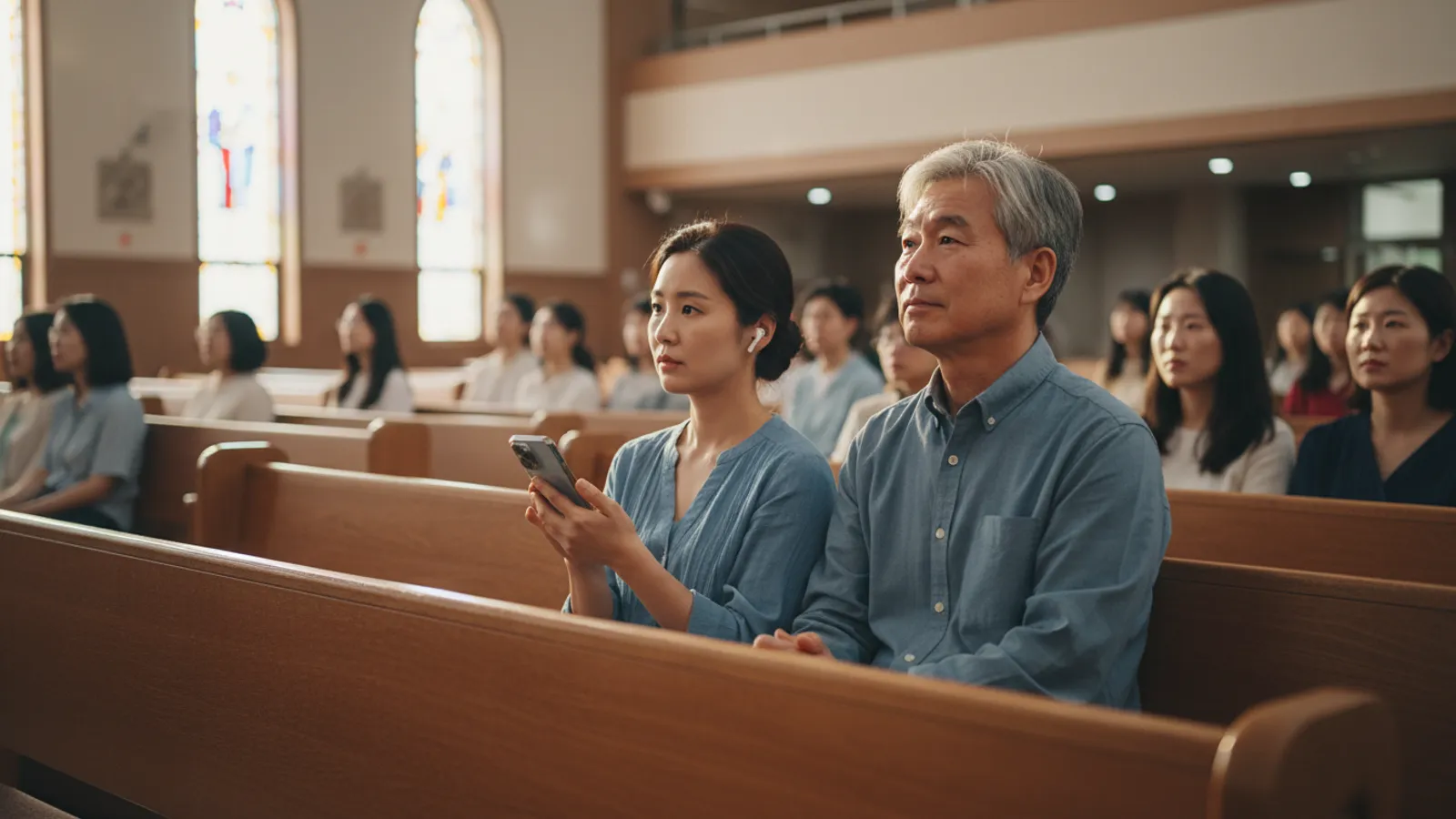
Most Korean churches outside Korea run two churches under one roof. The Korean Ministry (KM) worships in Korean with the senior pastor. The English Ministry (EM) meets at another hour or in another room, with its own pastor, for the second generation, their spouses and friends. Most Sundays that works well.
Then come the joint services: Easter, Thanksgiving, the church anniversary, a baptism Sunday, a funeral. The whole family is in one sanctuary and the sermon has to reach both groups. Parents who pray in Korean, and children who grew up thinking in English.
This guide is for pastors, EM leaders and media teams planning Korean and English ministry translation for those Sundays, and for the families who would like to sit together more often.
Two directions, one service
- Korean sermon, English listeners. The senior pastor preaches in Korean. EM members, spouses who are not Korean and guests need it in English. This is the most common need.
- English sermon, Korean listeners. The EM pastor preaches at a joint service, or a guest speaker comes in. First-generation members and visiting grandparents need it in Korean.
At a joint service you often get both within the hour. The welcome is in Korean, the EM pastor reads Scripture in English, the testimony is in whichever language the person is most comfortable with.
The usual options
Sentence-by-sentence interpretation on stage
A bilingual pastor or elder stands next to the preacher and repeats every sentence in the other language. It is familiar and it shows the two ministries together, and it doubles the sermon. Most preachers cut their message in half to fit, and the jokes and stories are the first to go.
Headsets and a volunteer interpreter
Simultaneous interpretation into receivers keeps the sermon at full length. It needs a fluent volunteer who can keep up for forty minutes, a quiet spot, transmitters and a box of receivers to hand out, charge and collect. The same few people carry it every time, and Scripture read at speed is where even good interpreters slip.
Slides in both languages
Bilingual slides cover the passage and the outline. They miss what the pastor adds on the day, which is most of what people remember.
Live AI interpretation on phones
A laptop at the sound desk takes the feed from the mixer. Each sentence is interpreted as it is spoken and reaches listeners' phones as captions and a natural AI voice, about two seconds after the preacher finishes it. Listeners scan a QR code, choose English or 한국어, and put in their earphones. Nobody installs an app or creates an account.
Heartongue detects the language of every sentence, so a joint service that moves between Korean and English is followed correctly by both groups without anyone pressing a button. It is machine interpretation, so it can stumble on an unusual name or a noisy feed. That is why your team can fix names and terms in a glossary during the service.
Why church Korean is harder than everyday Korean
General translation apps handle everyday Korean well enough. A sermon is a different job, and Korean Christians hear the difference at once.
Bible verses from an English Bible
When the senior pastor reads Psalm 23 in Korean, EM listeners should not get a fresh paraphrase made up on the spot. Heartongue recognizes the passage and shows the verse from an English Bible, marked 📖 with the reference. In a Protestant church that is the Berean Standard Bible:
The LORD is my shepherd; I shall not want. (Psalm 23:1)
In a Korean Catholic community it is the World English Bible, Catholic edition:
The LORD is my shepherd; I shall lack nothing. (Psalm 23:1)
When the pastor quotes only part of a verse, the English follows that Bible's wording instead of inventing its own. A young adult who knows "I can do all things through Christ who gives me strength" reads that line, not something close to it.
One honest note for the other direction: the Korean Bibles churches read from are under copyright, and Heartongue includes only free, public-domain or openly licensed Bibles. Verses read in English are interpreted into Korean with your tradition's words, not quoted from a printed Korean Bible. For Korean listeners, the church words and the prayers carry the most weight.
Church words by tradition
Korean Catholics and Protestants use different words for God, for the apostles and even for the names of Bible books. A translation that mixes them sounds like another church.
| English | Catholic Korean | Protestant Korean |
|---|---|---|
| God | 하느님 | 하나님 |
| Paul | 바오로 | 바울 |
| Holy Communion | 성체성사 | 성찬 |
| Pastor / priest | 신부 | 목사 |
| Exodus | 탈출기 | 출애굽기 |
| Matthew | 마태오 복음서 | 마태복음 |
Heartongue knows which tradition each congregation belongs to and uses its words, from a list of more than 1,000 church terms in every language. A Korean Presbyterian church hears 하나님 and 바울; a Korean Catholic community hears 하느님 and 바오로.
Prayers as the congregation prays them
When the EM pastor leads the Lord's Prayer in English, first-generation members do not need a new translation. They need the prayer they have prayed since childhood. A Korean Protestant church prays:
하늘에 계신 우리 아버지여, 이름이 거룩히 여김을 받으시오며, 나라가 임하시오며…
A Korean Catholic parish prays it differently:
하늘에 계신 우리 아버지, 아버지의 이름이 거룩히 빛나시며 아버지의 나라가 오시며…
Heartongue uses each congregation's wording for the Lord's Prayer, the Creeds, the Glory Be and, in Catholic parishes, the Hail Mary, so people can pray along out loud in their own language.
Natural phrasing, not word for word
Korean sermons carry expressions that fall apart word for word. 은혜받았습니다 translated literally becomes "I received grace", which sounds odd to an English speaker after a worship song. Translated by meaning, it is closer to "that really blessed me" or "God really spoke to me". The same goes for English sermon phrases on the way into Korean: "God has your back", "a mountaintop experience", "let's close in prayer". Good interpretation keeps sentences whole, translates by meaning, and keeps announcements and family news in plain everyday language, without a Bible voice where there is none.
Setting it up for a joint service
- Create your church in the app and a room for the service. Every room offers all 49 languages, Korean and English included.
- Connect the sound desk. A line from the mixer into a laptop gives far cleaner audio than a microphone in the room, and clean audio matters more than anything else for accuracy.
- Add your names to the glossary. The pastors' names in Korean and English, the church's name, and ministry words like 구역, 목장 or 새벽기도 with the English your EM uses for them.
- Print the QR code once. Each room keeps the same QR code and link, so it can go in the bulletin, on a card in the pews or on the screen before the service.
- Tell both groups. One line in each language in the bulletin is enough: "QR 코드를 스캔하고 한국어를 선택하세요" and "Scan the QR code and choose English."
For older members, show them the A+ button for larger captions and the contrast button for yellow text on black; the phone remembers both. If the sanctuary has a screen, a presenter screen can show the captions for the whole room. Ask everyone on phones to use earphones so the room stays quiet.
Ask two listeners for a few weeks
Before a big joint service, try it on an ordinary Sunday and ask two people to follow along: one KM elder in Korean and one EM member in English. They will catch a wrong name or an odd phrase long before anyone else, and every fix goes into the glossary for good.
Try it at a real service
Heartongue gives every new church 2 free language-hours to try it at a real service, with no card. After that, the Chapel plan is $49 a month for 15 language-hours, and the Parish plan at $149 a month covers every regular service in every language. See how Korean translation for church works, or read how churches plan a bilingual church service.
More from the blog
Funeral Mass in Spanish: Planning for a Bilingual Family
Heartongue8 min read
How a parish plans a funeral Mass in Spanish or for Spanish- and English-speaking relatives: readings, homily, words of remembrance, interpretation.
Midnight Mass in Spanish: Planning a Bilingual Christmas Eve
Heartongue8 min read
How a parish plans Midnight Mass in Spanish, or one Christmas Mass for Spanish- and English-speaking families: readings, music, homily, interpretation.
Church Translation App: How to Test One Before Sunday
Heartongue7 min read
A church translation app can sound fine in a demo and fail at Mass. Five tests for a weeknight: a Bible verse, a prayer, church words, an idiom, announcements.
Try it at your next service
2 language-hours free, no card needed. Set up a room in five minutes.
 Product Hunt
 Indie Hackers
 Fazier
 StartupBase