
Bilingual Church Service: A Practical Planning Guide
How to plan a bilingual church service for two congregations: worship songs, Scripture, the sermon, announcements, and live interpretation on phones.
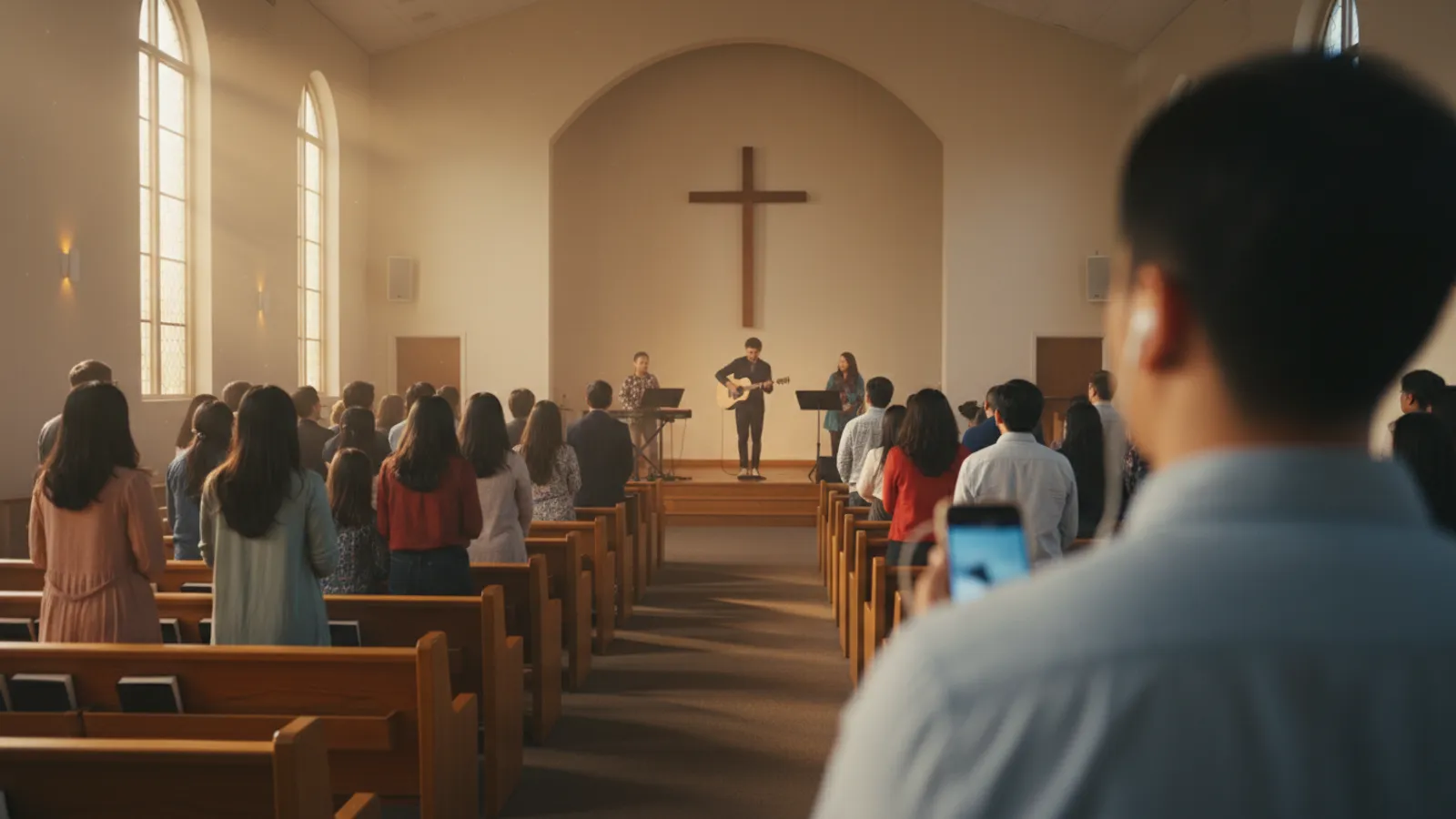
Many churches have two congregations under one roof. The English service meets at nine; the Spanish, Korean or Chinese ministry meets at eleven, or in the fellowship hall. They share a building, a budget and often a senior pastor, but they rarely worship together.
Then Easter comes, or a baptism Sunday, or the church anniversary, and the elders ask for one service for everyone. That is a bilingual church service: one gathering, two languages, one church.
This guide is for the pastors, worship leaders and ministry coordinators who plan it.
Decide what the service is for
Before choosing songs, decide why you are meeting together.
- A celebration (Easter, Christmas Eve, an anniversary): the goal is unity. It is fine if the sermon is short and the singing is long.
- A teaching Sunday (a vision series, a members' meeting): the goal is that everyone understands every word. The sermon and the announcements matter most.
- A regular combined service (monthly or every week): the goal is a rhythm both congregations can live with for years. Simplicity beats creativity.
Sort the service into three kinds of parts
The easiest way to plan is to look at each part of the service and ask what kind of part it is.
Parts people can do in their own language at once
Singing, the Lord's Prayer, a responsive reading, a benediction everyone knows. These do not need translation. They need both texts in front of people.
For worship songs, choose songs that exist in both languages with the same melody. Many well-known hymns and worship songs do. Put both lyrics on the screen, one above the other, and let each person sing in their own language. A room singing the same song in two languages at once is often the moment people remember.
Parts that are short and prepared
Scripture readings, prayers of the people, the welcome, the offering. These can be prepared in both languages ahead of time.
A common pattern: read the passage in one language while the other text is on the screen, then switch for the next reading. For the prayers, alternate speakers, one prayer in each language, with a short response everyone can say. Keep each part short so the other half of the room never waits long.
Parts that are long and unscripted
The sermon, the testimony, a baptism story, the pastoral prayer that runs long. This is where bilingual services usually break down, because nothing can be printed in advance and every word matters.
Three ways to handle the sermon
Preach twice. The pastor preaches in English, then the associate pastor preaches the same message in Korean. Everyone hears it fully, but the service gets long, and the second sermon is usually shorter. People notice.
Stage interpretation. The preacher speaks a sentence or two, then an interpreter beside them repeats it in the other language. This is common at conferences and many churches do it well. The room hears both languages and a good interpreter carries the preacher's energy. But the sermon takes almost twice as long, the preacher has to break every thought into short pieces, and it depends on one volunteer who must be excellent, prepared and available every time.
Preach once, interpret live. The pastor preaches once at a normal pace, and the other congregation follows through simultaneous interpretation. Until recently that meant a trained interpreter in a back room plus receivers and headsets for everyone. Today it can also mean live interpretation on people's own phones.
None of these is wrong. Stage interpretation is a good fit for a short joint service once a year. If the joint service is regular, or if a third language group shows up, preaching once with live interpretation usually keeps the service at a normal length.
Live interpretation for a bilingual service
This is what Heartongue does. A laptop at the sound desk takes the audio from your mixer. People scan a QR code on the screen or in the bulletin, choose their language, and follow on their own phone with captions and a natural AI voice, about two seconds after each sentence. There is no app to install and no receivers to hand out.
For a bilingual service, that changes a few things:
- The sermon is preached once. The pastor preaches in English at a normal pace, and Spanish speakers follow in Spanish on their phones.
- Switching languages is handled. Heartongue detects the language of every sentence. If the welcome is in Korean, the testimony in English and the closing prayer in Korean again, each listener keeps following in their own language.
- More than two groups can follow. One broadcast serves several languages at once, from 49. The grandmother who only speaks Vietnamese and the exchange students from Brazil can follow too, without a third language on stage.
- The overflow room can see it. A presenter screen shows the captions in the fellowship hall.
It is machine interpretation and it is not perfect: a name can come out wrong, and poor audio makes everything harder. For prayer ministry or pastoral care after the service, a person who speaks the language is still the right answer.
Why the wording matters
A generic translation app held up to the pulpit translates word for word, invents its own wording for Bible verses, mixes Catholic and Protestant vocabulary, and cuts sentences in half. People notice at once.
Heartongue translates the way your church speaks. When the pastor reads a verse, each listener reads that verse from a Bible in their own language, marked 📖 with the reference. Acts 2:8, a fitting verse for a bilingual Sunday:
English (Berean Standard Bible): "How is it then that each of us hears them in his own native language?"
Spanish (Reina-Valera 1909): "¿Cómo, pues, les oímos nosotros hablar cada uno en nuestra lengua en que somos nacidos?"
Chinese (和合本): "我们各人怎么听见他们说我们生来所用的乡谈呢?"
Heartongue ships 37 free, public-domain or openly licensed Bibles. Licensed editions such as the NIV are not included, so if your Spanish ministry reads the NVI, quoted verses will appear in the Reina-Valera 1909 wording instead. Say so to your people at the start.
Church words follow your tradition too. A Protestant congregation hears la Santa Cena for the Lord's Supper, not the Catholic la Eucaristía; Korean listeners read 하나님, not 하느님. The Lord's Prayer appears in the wording each congregation prays. Your team can add the names of your pastors, your church and your ministries to a glossary, even during the service.
The everyday parts stay everyday. The announcement about the church picnic or the youth retreat sounds like an announcement, not like Scripture. Expressions like "born again" or "let's stand for the closing song" are translated by what they mean, not word for word.
A planning checklist
- Plan with both pastors. Agree on the purpose, the order of service and who leads what. Share it with the worship team three weeks ahead.
- Pick songs both congregations know. Two or three songs in both languages beat six songs half the room cannot sing.
- Build bilingual slides. Lyrics in both languages, the Scripture passage in both, and the QR code for live interpretation on the welcome slide.
- Choose readers and prayer leaders from both congregations. Each speaks in their strongest language.
- Brief the preacher. One sermon at a normal pace, clear sentences, and the Bible references said out loud ("John chapter three, verse sixteen") so listeners can find the verse.
- Test the sound on a weekday. Run a line from the mixer to the interpretation laptop. Clean audio matters more than anything else.
- Say it once from the front. "If you'd like to follow in Spanish, scan the code on the screen and pick your language." Say it in both languages.
- Ask afterwards. Ask a few people from each congregation what worked. Add any names or terms that came out wrong to the glossary.
What it costs
Heartongue counts language-hours: one hour of broadcasting translated into one language that someone is actually listening to. A ninety-minute bilingual service followed in English and Spanish uses three language-hours. Languages nobody listens to are not charged.
Every church starts with 2 free language-hours. After that it is $4 per language-hour, or the Parish plan at $149 a month, which covers every regular service in any number of languages without counting hours. The full details are on the pricing page.
Start with one Sunday
You do not need to merge two congregations to hold a bilingual service. Pick one Sunday, plan it with both pastors, choose the songs both groups love, and let the sermon be preached once. Then ask the people in the seats how it went.
See how Heartongue works as a church translation system, or how Spanish translation for church works on a regular Sunday. For Catholic parishes, our guide to the bilingual Mass covers the readings, the music and the homily.
More from the blog
Vietnamese Church Service Translation: A Parish Guide
Heartongue7 min read
How parishes and churches translate Mass or a Sunday service into Vietnamese live, and why Catholic and Protestant wording matters to every listener.
Sermon Translation: Live Options for Churches and Parishes
Heartongue7 min read
How to translate a sermon or homily live so every language group can follow: volunteer interpreters, printed notes, captions and AI interpretation on phones.
Bilingual Mass: How to Plan One Your Parish Can Follow
Heartongue8 min read
A practical guide to planning a bilingual Mass for two language communities, from readings and music to the homily, with options for live interpretation.
Try it at your next service
2 language-hours free, no card needed. Set up a room in five minutes.
 Product Hunt
 Indie Hackers
 Fazier
 StartupBase