
Mass Responses in Spanish: A Pew Guide for Parishes
The short responses of the Mass in Spanish, part by part, with ustedes and vosotros, where they come from, and how English speakers can follow the homily.
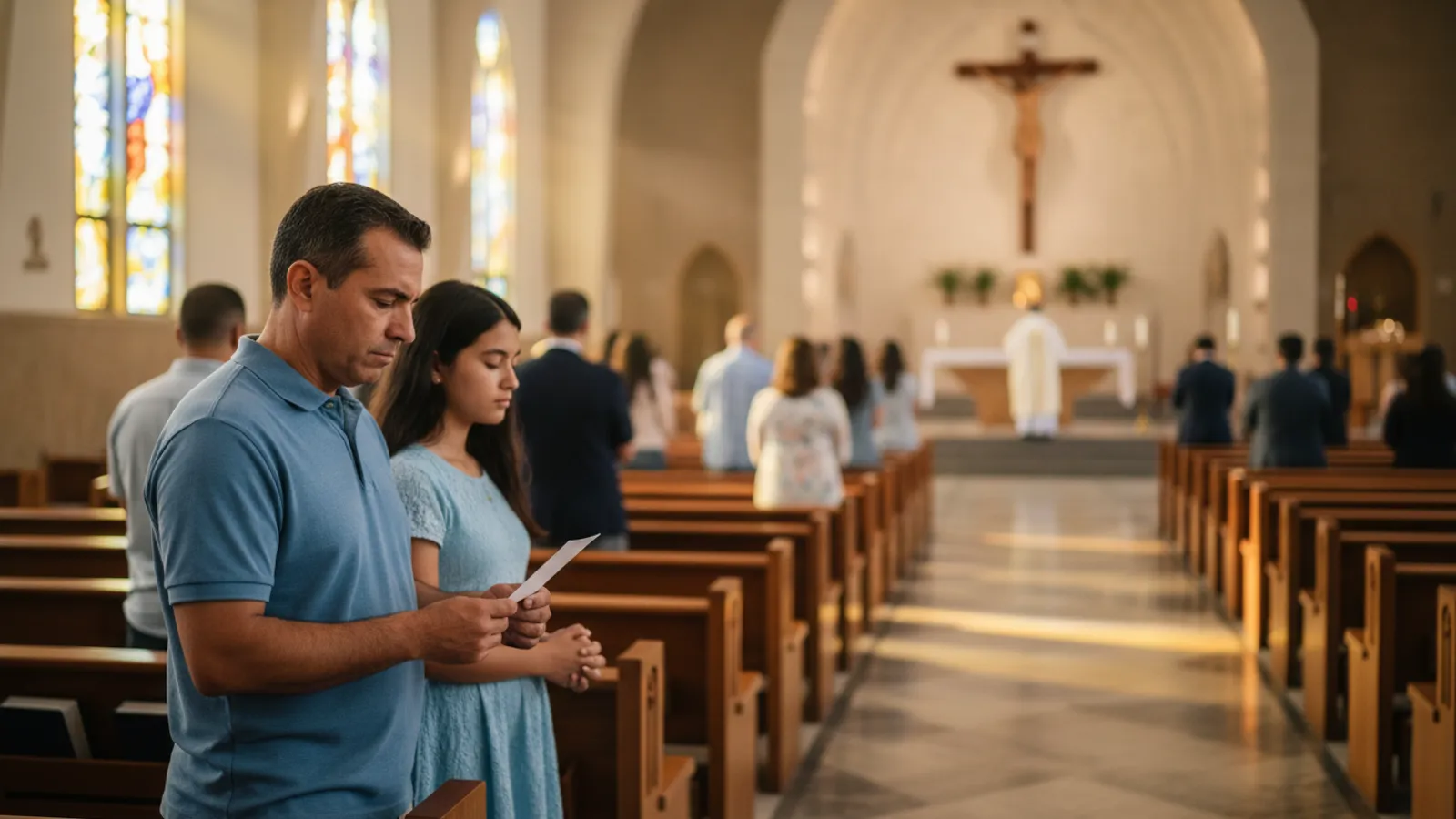
The first time an English speaker goes to a Spanish Mass, the order is familiar and the words are not. They know when to stand and when to kneel, they know that something is said back after "The Lord be with you", and then the whole church answers in Spanish while they stay quiet.
The good news is that the responses are short and they repeat every week. A family member, a new parishioner, a bilingual couple or a priest still learning Spanish can usually say them after two or three Sundays with a card in hand.
This guide lists the people's responses at a Spanish Mass, part by part, notes where wording differs between countries, and shows where they come from. At the end, it looks at the part a card cannot cover: the homily.
First: ustedes or vosotros?
Spanish missals differ slightly by country. The biggest difference is how the priest addresses the congregation:
- In the United States, Mexico and Latin America, the priest says ustedes: "El Señor esté con ustedes."
- In Spain, he says vosotros: "El Señor esté con vosotros."
The people's answers are almost always the same everywhere. If your parish prints a card, copy the wording from the missalette in your own pews, not from a website, so that the card matches what people hear.
The introductory rites
The Mass begins with the sign of the cross: "En el nombre del Padre, y del Hijo, y del Espíritu Santo." The people answer Amén.
Then the greeting:
- Priest: "El Señor esté con ustedes."
- People: Y con tu espíritu.
In the penitential act, the people repeat what the priest or cantor says:
- Señor, ten piedad. (Lord, have mercy.)
- Cristo, ten piedad. (Christ, have mercy.)
After the opening prayer, the people answer Amén again. Most of the Mass works like this: a short call, a short answer, and an Amén to close each prayer.
The Liturgy of the Word
After the first and second readings:
- Lector: "Palabra de Dios."
- People: Te alabamos, Señor. (Thanks be to God.)
Before the Gospel:
- Priest or deacon: "Lectura del santo Evangelio según san Lucas."
- People: Gloria a ti, Señor. (Glory to you, O Lord.)
After the Gospel:
- Priest or deacon: "Palabra del Señor."
- People: Gloria a ti, Señor Jesús. (Praise to you, Lord Jesus Christ.)
The responsorial psalm changes every Sunday, so a card cannot list it. The cantor sings the response once and the people repeat it; most people simply listen the first time and join in after.
After each petition of the prayers of the faithful, a common response is Te lo pedimos, Señor, but parishes vary, and the reader usually says it first.
The Liturgy of the Eucharist
The preface dialogue is the longest exchange, and the one newcomers miss most:
- Priest: "El Señor esté con ustedes."
- People: Y con tu espíritu.
- Priest: "Levantemos el corazón."
- People: Lo tenemos levantado hacia el Señor.
- Priest: "Demos gracias al Señor, nuestro Dios."
- People: Es justo y necesario.
Then everyone sings or says the Holy, Holy, which begins Santo, Santo, Santo.
After the consecration, the priest invites the memorial acclamation, and a common one is:
- Anunciamos tu muerte, proclamamos tu resurrección. ¡Ven, Señor Jesús!
The Eucharistic Prayer ends with the great Amén, often sung.
Communion and the dismissal
The Our Father is prayed by everyone (more on its wording below). At the sign of peace:
- Priest: "La paz del Señor esté siempre con ustedes."
- People: Y con tu espíritu.
The Lamb of God begins Cordero de Dios, que quitas el pecado del mundo, with the answer ten piedad de nosotros, and the third time danos la paz.
Before Communion, everyone says together:
- Señor, no soy digno de que entres en mi casa, pero una palabra tuya bastará para sanarme.
When receiving, the minister says "El Cuerpo de Cristo" and the communicant answers Amén.
At the end:
- Priest or deacon: "Pueden ir en paz." (In Spain: "Podéis ir en paz.")
- People: Demos gracias a Dios. (Thanks be to God.)
Where the words come from
Many responses are lines from Scripture, which is one reason they feel so weighty. "Lord, I am not worthy" comes from the centurion who asks Jesus to heal his servant, in Matthew 8:8. Here is that verse in two of the Bibles Heartongue ships:
English (World English Bible, Catholic edition): "Lord, I'm not worthy for you to come under my roof. Just say the word, and my servant will be healed."
Spanish (Santa Biblia libre para el mundo): "Señor, no soy digno de que entres bajo mi techo; solamente di la palabra, y mi criado sanará."
Put the verse next to the response, and you can see how the liturgy turned the centurion's roof into "mi casa" and his servant into the person praying. A parishioner who learns one learns something about the other.
The prayers everyone says together
The Our Father is where a bilingual congregation notices wording most, because Catholics and Protestants in Spanish learned different versions as children. The Catholic one begins:
Catholic: "Padre nuestro, que estás en el cielo, santificado sea tu Nombre; venga a nosotros tu reino…"
The version many Spanish-speaking Protestants pray begins:
Protestant: "Padre nuestro que estás en los cielos, santificado sea tu nombre. Venga tu reino…"
Close, but not the same, and anyone who has prayed one of them for forty years hears the difference at once. For the Creed and the Gloria, which are longer, point newcomers to the missalette rather than a card.
What a card cannot do: the homily
A response card helps someone take part. It does not help them understand the homily, the announcements or the intentions of the day, which change every week and are never printed.
That is where live interpretation helps. With Heartongue, a laptop at the sound desk takes the audio from your mixer; listeners scan a QR code, choose English, and follow the homily on their own phone, with captions and a natural voice, about two seconds after each sentence. The same broadcast can serve several languages at once, out of 49.
It is built to translate the way a Catholic parish speaks, which is exactly where general translation apps stumble:
- Prayers as people pray them. When the congregation prays the Our Father, the Hail Mary, the Creeds or the Glory Be, an English listener reads the wording English-speaking Catholics know, and a Spanish listener the Catholic Spanish version above, not a word-for-word guess.
- Verses from a real Bible. When the priest quotes a verse in the homily, listeners read it from a Bible in their own language and tradition, marked 📖 with the reference, as in the Matthew 8:8 example.
- Catholic words. La Eucaristía, not la Santa Cena; san Pablo, not el apóstol Pablo. More than 1,000 church terms in every language, plus a glossary your team can edit, even during Mass.
- Natural sentences. Sentences stay whole, and the announcement about the parish festival sounds like an announcement, not like Scripture.
It is machine interpretation, so it can still stumble over a name or a sentence lost in poor audio. For the homily and announcements every Sunday, it is often the most practical way for an English speaker to follow a Spanish Mass, or the other way around. More on the setup in our guide to the Catholic Mass in Spanish with English translation.
Making a response card for your parish
- Copy from your own missalette. Match the country edition your parish uses (ustedes or vosotros, the memorial acclamation your priest chooses).
- Keep it to one sheet. The responses above fit on one side; the Gloria and the Creed can stay in the missalette.
- Put the English next to each line, so that a newcomer knows what they are saying.
- Print the QR code for live interpretation on the back, so the same card helps with the homily.
- Leave cards at the entrance every week, not just at Christmas and Easter. Newcomers arrive on ordinary Sundays.
What it costs
Every parish starts with 2 free language-hours, enough to try live interpretation at one or two Spanish Masses. After that it is $4 per language-hour, the Chapel plan at $49 a month with 15 hours, or the Parish plan at $149 a month for every regular Mass in every language your parishioners need. The details are on the pricing page.
A few words, every Sunday
"Y con tu espíritu." "Te alabamos, Señor." "Demos gracias a Dios." A handful of short answers is enough for someone to stop being a visitor at the Spanish Mass and start praying it with everyone else. A card in the pew teaches the responses; live interpretation lets them follow everything in between.
See how Heartongue handles Spanish translation for church, or read our guide to the bilingual Mass.
More from the blog
Order of the Mass in Spanish: The Parts and Their Names
Heartongue8 min read
The order of the Mass in Spanish, part by part, with the Spanish name of each part, who leads it and what changes every week, for parish planners.
Catholic Mass in Tagalog With English Translation
Heartongue8 min read
How a parish can hold a Tagalog Mass that the whole family follows: the homily on each phone in English or Filipino, prayers as Filipinos pray them.
Catholic Mass in Polish With English Translation
Heartongue8 min read
The Mass responses in Polish and English side by side, and how a parish can let families follow a Polish Mass homily in English, or an English one in Polish.
Try it at your next service
2 language-hours free, no card needed. Set up a room in five minutes.
 Product Hunt
 Indie Hackers
 Fazier
 StartupBase
 SaaSHub