
How to Add Spanish Translation to an English Service
Four practical ways to add Spanish translation to an English church service, what each takes on a Sunday, and a step-by-step plan to start next week.
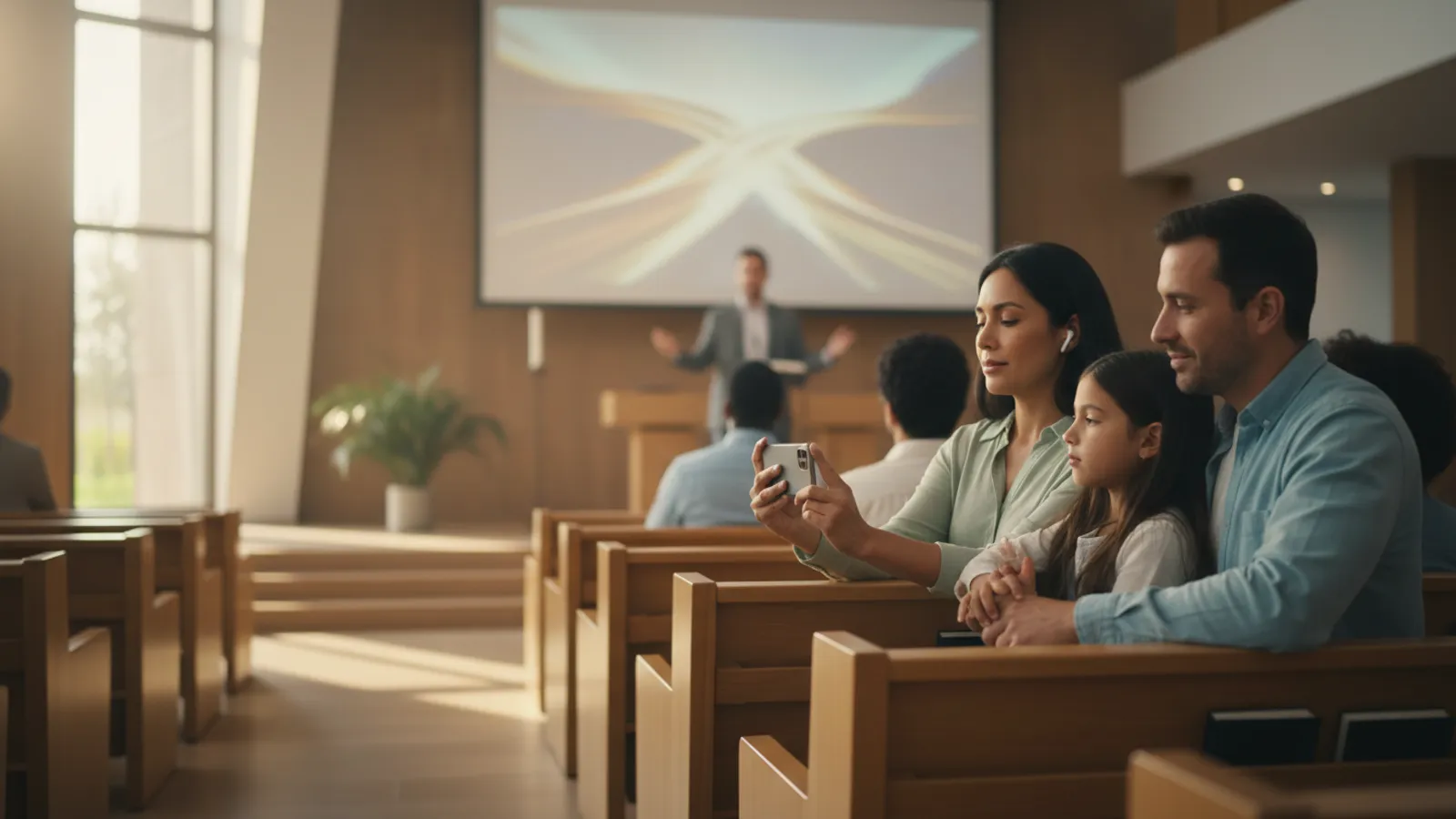
Maybe it started with one family who visits every week but leaves before the sermon. Maybe a member keeps translating for her parents in a whisper. Sooner or later someone asks: how do we add Spanish translation to our English service without starting a second service or rebuilding the sound system?
There are four realistic ways to do it. Each one works for some churches and not for others, so this guide walks through what each takes on a normal Sunday, then gives a simple plan to start.
Start with three questions
Before you pick a method, answer these honestly. They decide more than any piece of equipment.
- Who needs it, and for which parts? A few older members who follow the songs but lose the sermon need something different from a whole Spanish-speaking ministry that wants the full service.
- Who will run it every week? Every method needs at least one person. The question is whether that person must be a fluent interpreter or just someone at the sound desk.
- Where do the listeners sit? If they want to sit with their English-speaking family and friends, anything that needs a separate section or a separate room is a harder sell.
Option 1: Spanish slides and printed notes
The lightest start is to put Spanish on paper and on screen: translated song lyrics, Scripture readings in a Spanish Bible version, and a printed sermon outline or summary in Spanish.
- Good for: churches where the pastor prepares notes ahead of time, and listeners who understand some English.
- What it takes: someone to translate the outline every week before Sunday.
- The limit: it covers what was written down, not what was said. Illustrations, stories and anything the pastor adds on the spot are lost, and that is often the part people remember.
This is worth doing alongside any of the other options. Spanish song lyrics on the screen help people join in, whatever you do for the sermon.
Option 2: A bilingual service with a live interpreter
In a bilingual service the pastor speaks a sentence or two, pauses, and an interpreter on stage repeats it in Spanish. Everyone hears both languages.
- Good for: churches where the two groups are close in size and want to worship as one congregation, and special services like Christmas or baptisms.
- What it takes: a confident interpreter on stage every week, and a preacher willing to preach in short sections.
- The limit: the sermon takes close to twice as long for the same content, and English speakers hear everything twice. Many churches keep this for special occasions rather than every Sunday.
Option 3: A volunteer interpreter with receivers and headsets
This is the classic setup. A bilingual volunteer sits in a quiet corner or a booth and interprets into a microphone while the pastor speaks. A transmitter sends the voice to small receivers with headsets that Spanish speakers pick up at the welcome desk.
- Good for: churches that already have one or more skilled interpreters who can commit to a rotation.
- What it takes: the equipment (a transmitter, receivers and headsets), an interpreter at every service, and someone to charge, hand out, collect and clean the receivers.
- The limit: simultaneous interpreting is demanding work, and a 40-minute sermon is a long stretch for a volunteer. When the interpreter is sick or away, Spanish speakers get nothing that week.
If you go this way, we wrote a longer comparison of church translation equipment and phone-based systems.
Option 4: Live AI interpretation on listeners' phones
The newest option replaces both the interpreter and the receivers. A laptop at the sound desk takes the pastor's audio and the sermon is interpreted into Spanish as it is spoken. Listeners use their own phones as the receiver.
With Heartongue it works like this:
The operator opens the room's Broadcast page on a laptop, picks the mixer's output as the input, and presses Go live.
Spanish speakers scan a QR code from the bulletin or the screen, choose Español, and put in their earphones. There is no app to install and no account to create.
Each sentence arrives about two seconds after the pastor finishes it, as a natural Spanish voice and as captions on the screen. Listeners can turn either one off.
The same broadcast can also be interpreted into Vietnamese, Korean and Chinese if you have members who need those languages.
Good for: churches without a weekly interpreter, churches that want to serve more than one language, and listeners who want to sit anywhere in the room.
What it takes: a laptop with a line from the mixer, an internet connection, and a phone and earphones for each listener.
The limit: it is machine interpretation. It is good enough to follow a sermon, but it can make mistakes, especially with names, quotes and unclear audio. It is not the right tool for legal, medical or pastoral counselling conversations, where every word must be exact. It also only interprets from English, so a Spanish testimony will not be translated into English.
A step-by-step plan to start next Sunday
Whichever method you choose, the rollout looks much the same. Here is the plan using phones, since it is the one most churches can start without recruiting anyone new.
1. Ask the people who will use it
Talk to two or three Spanish-speaking members before you announce anything. Ask which parts of the service they struggle with and whether they would use a phone with earphones during the sermon. Their answers tell you whether to start with the sermon only or the whole service.
2. Get clean audio to the laptop
Translation quality depends on audio quality. Run a cable from a spare output on the mixer (an aux send or a recording output) to the laptop, rather than relying on a microphone in the room that also picks up the congregation and the band. Make sure the pastor's microphone is in that mix.
3. Teach it your church's names
Add the words that must always come out the same way to the room's glossary: your pastor's name, the church's name, ministry names, and any Bible books or terms your tradition uses in a particular way. Each entry has the English term and the Spanish you want to hear.
4. Test on a weekday
Play a recorded sermon through the mixer on a weekday, go live, and ask a Spanish-speaking member to listen on their phone for twenty minutes. Write down anything that sounds wrong and add it to the glossary.
5. Make it easy to join
Print the room's QR code in the bulletin and put it on the screen before the sermon with one line in both languages, for example: "Scan to hear the sermon in Spanish / Escanea para escuchar el sermón en español." Have a few spare pairs of cheap earphones at the welcome desk for people who forgot theirs.
6. Pick one operator
Choose one person at the sound desk who presses Go live before the service and stops the broadcast afterwards. It does not need to be someone who speaks Spanish. Give a second person access as a backup.
7. Ask for feedback after a month
After four Sundays, ask your Spanish-speaking members what works and what does not. Some churches keep AI interpretation for weekly services and invite a human interpreter for special events, which is a sensible mix.
What it costs
With Heartongue every new church gets 2 free language-hours to try it at a real service, with no card. After that it is $4 per language-hour (one hour of broadcasting interpreted into one language with at least one listener), or a monthly plan starting at $49 a month with 15 language-hours included. A one-hour service interpreted into Spanish only uses one language-hour, and languages nobody is listening to are not charged. Full details are on the pricing page.
The short version
- If you have a reliable bilingual volunteer, a live interpreter with receivers or a bilingual service can work well.
- If you don't, or you need more than one language, interpretation on listeners' own phones is the quickest way to start.
- Whatever you choose, add Spanish lyrics and Scripture on screen, feed clean audio, and ask the people who listen.
Ready to try it at your next service? See how Spanish translation for church works with Heartongue, or start with the free trial.
More from the blog
Church Translation Equipment vs. Phones: What a Small Church Needs
Heartongue4 min read
Transmitters, receivers and headsets, or the phones people already carry? How church translation equipment works, what it takes to run, and when each makes sense.
Try it at your next service
2 language-hours free, no card needed. Set up a room in five minutes.