
Church Translation Equipment vs. Phones: What a Small Church Needs
Transmitters, receivers and headsets, or the phones people already carry? How church translation equipment works, what it takes to run, and when each makes sense.
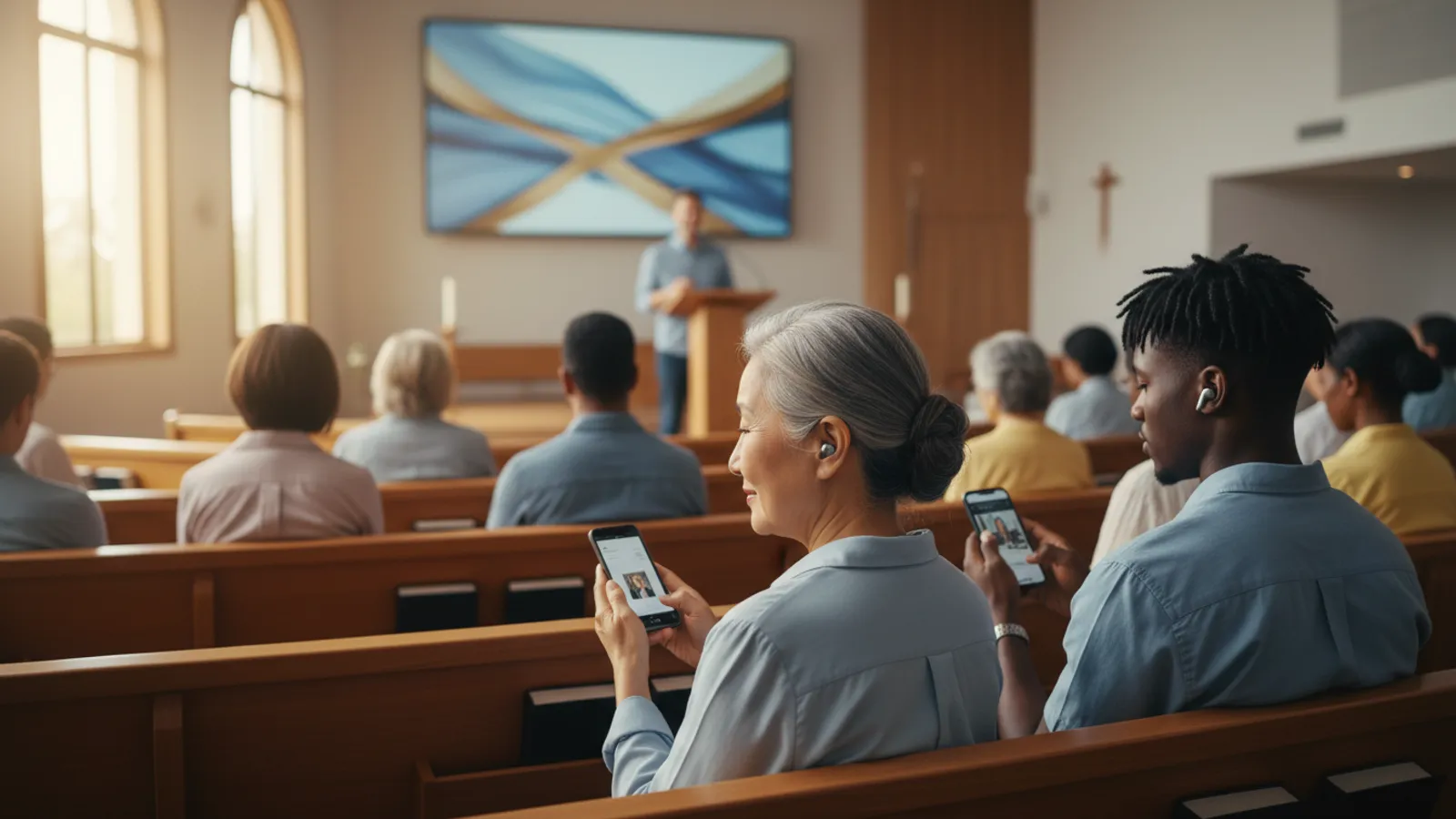
If part of your congregation would understand the sermon better in Spanish, Korean, Vietnamese or Chinese, the first search usually leads to church translation equipment: transmitters, receivers and headsets. It is a proven setup, but it is not the only one any more. This guide explains how each approach works, what it takes to run on a normal Sunday, and how to choose.
How traditional church translation equipment works
A classic interpretation system has four parts:
- An interpreter who listens to the speaker and says the same thing in the other language, usually from a quiet corner or a booth.
- A microphone and transmitter that carry the interpreter's voice over radio (FM or a similar band) or infrared.
- Receivers, small boxes with a channel selector, one per listener.
- Headsets or earpieces, one per receiver.
It works well when you have a skilled volunteer interpreter every week and a group of listeners who sit in the same room. The costs are mostly not on the invoice: someone has to recruit and schedule interpreters for every service, charge the receivers, hand them out, collect them, clean the headsets and replace the ones that disappear.
How phone-based translation works
With a phone-based system the listener's own phone is the receiver:
- A laptop at the sound desk takes the speaker's audio (from the mixer or a microphone).
- The sermon is translated as it is spoken, sentence by sentence. With Heartongue each sentence arrives about two seconds after the speaker finishes it, as a natural voice and as captions.
- Listeners scan a QR code printed in the bulletin or shown on screen, pick their language and put in their own earphones. Nothing to install and no account.
One service can serve several languages at once: a Vietnamese grandmother, a Korean exchange student and a Spanish-speaking family each hear the same sermon in their own language.
Side by side
| Receivers and headsets | Phones (AI interpretation) | |
|---|---|---|
| People needed each Sunday | An interpreter per language, plus someone to hand out and collect receivers | Someone to press "Go live" at the sound desk |
| Equipment to buy | Transmitter, receivers, headsets | A laptop you probably already have |
| Several languages at once | One interpreter and one channel per language | Every supported language in parallel |
| Quality | As good as your interpreter | Good enough to follow a sermon; can make mistakes with names and poor audio |
| Visitors who arrive late | Need a receiver from the welcome desk | Scan the QR code from their seat |
| Running cost | Volunteer time, batteries, replacements | Pay per language-hour actually listened to |
Which one should your church choose?
Choose a human interpreter with receivers when every word must be exact (legal, medical or membership matters), when you already have a team of reliable interpreters, or when the event is a one-off conference with a budget for professionals.
Choose phones when you are a small or mid-size church without a weekly interpreter, when you want to serve more than one language, or when listeners are spread across the room and you would rather not run a receiver desk. Many churches use both: AI interpretation for weekly services, a human interpreter for special events.
Making AI interpretation work well
- Good audio in, good translation out. Feed the laptop from the mixer rather than a room microphone.
- Teach it your names. Add the pastor's name, Bible books and ministry names to the glossary so they are translated the same way every time.
- Tell people once. Put the QR code in the bulletin and on the screen before the sermon, with one line: "Scan to hear the sermon in your language."
- Test with a real listener. Ask one member who speaks the language to listen for a week and tell you what sounds wrong.
Try it
Heartongue gives every new church 2 free language-hours to try it at a real service. See how it works for Spanish, Korean, Vietnamese and Chinese, or read about a church translation system without receivers.
Try it at your next service
2 language-hours free, no card needed. Set up a room in five minutes.